Malaga Alcazaba 2026: Tickets, Hours & What to Expect Inside
The Alcazaba is the reason Malaga looks the way it does. The fortress sits above the Roman Theatre at the edge of the historic centre, its 11th-century walls visible from half the city, and the view from the top — port, cathedral, Mediterranean — is the best in Malaga at any price. At €7.00, it's one of the best-value monuments in Spain.
Most visitors spend 45–75 minutes inside. This guide covers what you'll actually see, when to go, and whether the guided tour is worth it over a self-guided visit.
Quick Takeaways
- ✓Entry costs €7.00. The combo ticket with Castillo de Gibralfaro is €10.00 — a saving of €4 and both sites are worth doing on the same day.
- ✓The best time to visit is 09:00–10:30 (before tour groups arrive) or after 17:00 in summer when the light on the stone is exceptional.
- ✓Self-guided visits are perfectly manageable — the layout is linear and well-signed. A guided tour adds historical depth but is not necessary to appreciate the site.
- ✓The Roman Theatre at the base is free to view from the street and takes 10 minutes. Combine it with the Alcazaba as a natural starting point.
- ✓There is no timed entry system — you can buy tickets at the gate on the day. In July–August, arrive early to avoid the midday crowd.
- ✓The lift from street level to the main entrance is signposted from Calle Alcazabilla — useful for visitors with pushchairs or mobility considerations.
Jump to: What's Inside · Tickets & Hours · Self-Guided vs Tour · Roman Theatre · Gibralfaro Combo · Getting There · FAQ
The Alcazaba connects naturally into a full morning in the historic centre — the things to do in Malaga guide shows how it fits alongside the cathedral, Picasso Museum, and port. The Malaga travel guide covers everything else you need to plan your visit.
What's Inside the Alcazaba
The Alcazaba is a Moorish palace-fortress built in 1057 by Badis, king of the Taifa of Granada, on the foundations of a Roman structure. It's not a ruin — the restoration is extensive and the interior spaces are genuinely inhabitable-looking, which makes it more affecting than many equivalent sites.
The visit follows a single route uphill through a sequence of gates, gardens, and palace rooms. The defensive logic becomes clear as you walk — each gate is angled to slow attackers, and the narrow ramps between walls would have been lethal under fire.
The Gardens and Courtyards
The gardens between the lower and upper palace are the Alcazaba's most photographed spaces — small courtyard fountains, orange and jasmine plantings, Moorish arches framing the sky. In spring and early summer the jasmine scent at the upper courtyard is genuinely remarkable.
These spaces were designed for pleasure as much as defence. The contrast between the military fortifications outside and the domestic tranquillity of the palace interiors is one of the site's most interesting tensions.
The Palace Rooms
The upper palace contains a series of rooms that now house the Museo Arqueológico Municipal — a small but well-curated collection of Roman, Phoenician, and Moorish artefacts found on and around the site. It's included in the entry price and worth 15 minutes of your time.
The horseshoe arches throughout the palace rooms are the architectural signature of the Alcazaba. The proportions here are smaller and more intimate than the Alhambra in Granada — which makes the detail easier to appreciate at close range.
The View from the Top
The terrace at the highest point of the upper palace gives a panoramic view over Malaga port, the cathedral, the coastline east toward Nerja, and on clear days the mountains behind the city. It's the best elevated view in the historic centre — better than most of the rooftop bars and free with the entry ticket.
The view is significantly better in the morning or late afternoon than at midday. In summer, the eastern light on the palace walls before 11:00 is the best photography window. The late afternoon light from around 17:30 is the second best — and the site is noticeably less crowded after 17:00.
Tickets, Prices & Opening Hours 2026
| Ticket | Price |
|---|---|
| Alcazaba only (general) | €7.00 |
| Alcazaba + Gibralfaro combo | €10.00 |
| Reduced (students, 65+, disabled) | €3.00 solo · €5.00 combo |
| Groups (10+) | €5.00 solo · €8.00 combo |
| Under 6 | Free |
| Sundays from 14:00 | Free |
Opening hours vary by season. Summer (1 April–31 October): 09:00–20:00, last entry 19:00. Winter (1 November–31 March): 09:00–18:00, last entry 17:00. Confirm current hours at the ticket office or on the official Malaga tourism site before visiting — hours shift with the clocks.
The Alcazaba is closed on certain public holidays. There is no timed-entry booking system — tickets are purchased at the gate. In July and August, arriving before 10:00 or after 17:00 avoids the peak crowd. Midday in summer is the worst window: hot, busy, and the light is flat.
The combo ticket (€10.00) saves €4 versus buying both sites separately. Gibralfaro is a 20-minute walk uphill from the Alcazaba — or take Bus 35 from Paseo del Parque. Do the Alcazaba first (lower elevation, more detailed), then walk up to Gibralfaro for the city panorama.
Self-Guided Visit vs Guided Tour
The Alcazaba is perfectly navigable without a guide. The route is linear, the signage is adequate, and the physical spaces speak for themselves. A self-guided visit at your own pace is the right choice for most visitors.
A guided tour adds genuine value in one specific way: the historical context. The layered history — Phoenician, Roman, Moorish, Reconquista — is visible in the stonework throughout the site, but without context most of it looks like old wall. A good guide turns the architecture into a narrative.
The combined Alcazaba and Roman Theatre guided tour (approximately 2 hours) is the most efficient way to cover both sites with context. Groups are typically small and the price is reasonable relative to what you get.
The Roman Theatre — Free, 10 Minutes, Don't Skip It
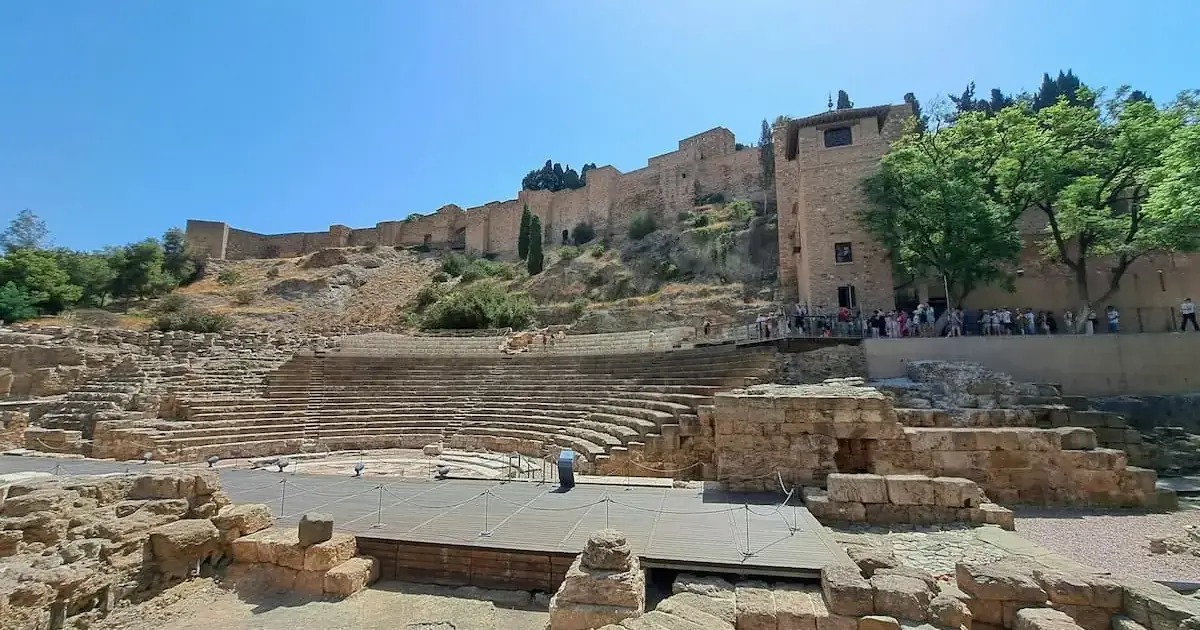
At the base of the Alcazaba, on Calle Alcazabilla, is a 1st-century BC Roman theatre — one of the oldest in Spain and genuinely impressive in scale. Entry to the viewing area is free.
The theatre was buried under centuries of construction (including part of the Alcazaba itself) and only rediscovered in 1951 during building works. The viewing platform gives a clear view of the semicircular seating rows and stage. The interpretation centre inside is small but explains the excavation story well.
It takes 10 minutes and costs nothing. There is no reason to walk past it.
Castillo de Gibralfaro — Is the Combo Worth It?
Gibralfaro is the castle on the hill above the Alcazaba — connected to it historically (and once by a defensive corridor called the coracha) but a separate site with a separate entrance. The combo ticket at €10.00 covers both — saving €4 on separate entry.
The Gibralfaro itself is sparser than the Alcazaba — less interior detail, more military structure. Its value is the panoramic view from the ramparts, which is the best in Malaga at any elevation. The city spreads below in every direction, the bullring is directly below, and on clear days you can see the coastline curving toward Gibraltar.
The walk up from the Alcazaba takes 20–25 minutes on a steep path through pine trees. Bus 35 from Paseo del Parque stops near the entrance if the walk isn't appealing.
Getting There
The Alcazaba entrance is on Calle Alcazabilla, directly adjacent to the Roman Theatre. It's a 5-minute walk from the cathedral, 10 minutes from the Picasso Museum, and 15 minutes from the port on foot.
There's no practical reason to take public transport from the historic centre — the walk is flat and direct. From further out, Bus 35 stops on Paseo del Parque, a 5-minute walk from the entrance.
The lift from street level to the main Alcazaba gate is signposted from Calle Alcazabilla. It handles pushchairs and wheelchairs and is reliable. The ramp alternative is possible but steep.
For visitors combining the Alcazaba with a boat tour on the same day: the port is 15 minutes' walk from the entrance. The Alcazaba in the morning, boat tour at sunset is a natural pairing and one of the better full days in Malaga.
FAQ
How much does the Alcazaba cost in 2026? €7.00 for general admission. The combo ticket with Castillo de Gibralfaro is €10.00 — saving €4 on separate entry. Reduced rate (students, over-65s, disabled): €3.00 solo / €5.00 combo. Under-6s enter free. Entry is free for everyone on Sundays from 14:00.
Do I need to book tickets in advance? No — the Alcazaba does not use a timed-entry booking system. Tickets are purchased at the gate on the day. In July–August, arrive before 10:00 or after 17:00 to avoid peak crowds. There is no risk of selling out in the way the Alhambra does.
How long does the Alcazaba take to visit? 45–75 minutes for a self-guided visit at a comfortable pace, including the palace rooms and museum. Add 20 minutes if you read all the interpretation panels. A guided tour runs approximately 90 minutes to 2 hours including the Roman Theatre.
Is the Alcazaba suitable for children? Yes, well suited. The gardens and courtyards are engaging, the route is manageable for older children, and the views are immediately rewarding. The main ramp is steep — the lift is the better option with a pushchair.
What's the difference between the Alcazaba and Gibralfaro? The Alcazaba is the lower palace-fortress — rich in architectural detail, palace rooms, and gardens. Gibralfaro is the upper military castle — sparser inside but with the best panoramic view in Malaga. They were historically connected and are best visited together on the same day.
Is the Alcazaba better than the Alhambra in Granada? Different scale, different experience. The Alhambra is larger, more elaborate, and requires advance booking months ahead. The Alcazaba is intimate, unbooked, and €7.00. For a half-morning in Malaga it's exceptional value. For a dedicated Nasrid palace experience, the Granada day trip covers the Alhambra properly.
Can I visit the Alcazaba and Picasso Museum on the same day? Easily — they're 10 minutes apart on foot. Alcazaba in the morning (best light, fewer crowds), Picasso Museum after lunch is the natural sequence. The 3-day Malaga itinerary shows how to combine both without rushing either.