
Málaga is not a beach town you can wing. Walk-up tickets at the top sights are often gone, cruise crowds fill the centre between 10:00 and 15:00, and the difference between a good day and a queue is about three decisions made before you fly. This page names those decisions, gives the 2026 prices, and says plainly which sights you can skip.
The Big Three, and the ticket price most guides still get wrong
The Alcazaba, Gibralfaro Castle and the Cathedral sit within ten minutes of each other and carry any first visit. The Alcazaba is an 11th-century Moorish palace-fortress above the Roman Theatre, and it is the single strongest sight in the city. Gibralfaro is 130 metres further up the same hill and is really about the view. The Cathedral is a separate ticket and a separate building altogether.
| Ticket | Price |
|---|---|
| Alcazaba alone | €7.00 |
| Alcazaba + Gibralfaro combined | €10.00 |
| Reduced, either monument alone | €3.00 |
| Reduced, combined | €5.00 |
| Under 6 | Free |
| Everyone, Sunday from 14:00 | Free |
Two singles cost €14, so the €10 combined ticket saves €4 if you are doing both, which you should – they are on the same hill. Buy it at whichever monument you reach first.
If a guide quotes you €3.50 or €5.50, it is reading a dead page
Skip Gibralfaro's ticket if the view is all you want. The mirador on the road outside the gate is free, open at any hour, and gives you most of the panorama without a turnstile.
The Cathedral's rooftop tour is the one thing here you cannot currently book at any price. Roof works began in April 2024 under a €5.3m EU-funded project, and rooftop visits are suspended until the works complete at the end of 2027. The interior is open and normal – the cathedral guide covers what the €10 interior ticket includes.
Where everything actually is
The Alcazaba, Gibralfaro, Cathedral, Atarazanas and Soho all sit inside the walkable core shown above – nothing on that cluster is more than a 15-minute walk from anything else in it. The two things this map does not show: Pedregalejo and El Palo, the beaches for espetos, are 4km east along the coast by bus, and Málaga Airport is 8km southwest.
Soho, the street-art district most visitors miss
Soho sits on the west bank of the Guadalmedina riverbed, a five-minute walk from Atarazanas, and it is the thing this page is most likely to convince you to add.
Since 2013 the MAUS project (Málaga Arte Urbano Soho), run jointly by the city and CAC Málaga, has commissioned international street artists to paint the neighbourhood's walls – D*Face and ROA from the UK and Belgium, Obey (Shepard Fairey) from the US, Ben Eine from London, and Spain's own Boa Mistura among them.
The best-known piece is a joint work by Obey and D*Face on the riverside wall, 38 metres tall and 9 metres wide, which took the two artists three days to finish.
Allow about 45 minutes to walk the main murals at an easy pace, starting from the river and working inland. The dry riverbed itself has become an informal skate spot, which adds to the district's genuinely un-touristy feel next to a city centre that can otherwise feel curated for visitors.
CAC Málaga anchors the district and is already the best free contemporary-art stop in the city (see the museums table below) – walking Soho and stepping into CAC is naturally one visit, not two separate trips. Free, no ticket, no booking, and the single highest value-for-time addition to a Málaga itinerary that most guides still leave out.
Which museums actually need booking
Málaga has over 30 museums and you need two or three. The Picasso is the anchor: 233 works across a 16th-century palace, covering his whole career.
| Museum | Focus | Price | Pre-booking |
|---|---|---|---|
| Museo Picasso | Picasso's full career | €13 · €11 reduced | Essential in season |
| Centre Pompidou | Modern and contemporary | from ~€9 | Recommended |
| Carmen Thyssen | 19th-century Andalusian art | from ~€10 | Walk-up usually fine |
| Museo del Automóvil y la Moda | Cars and fashion, 1900s–now | €10 · €8 reduced | Not needed |
| CAC Málaga | Contemporary art | Free | Not needed |
| Museo de Málaga | Archaeology and fine art | Free for EU citizens | Not needed |
The Picasso is free for under-17s, for visitors with disabilities, and for everyone during the last two hours of every Sunday, plus four fixed dates a year: 28 February, 18 May, 27 September and 27 October. The reduced €11 rate covers over-65s, students under 26 and European Youth Card holders.
The Museo del Automóvil y la Moda is honestly the most skippable of the six for most visitors – it is a genuinely good collection (6,000m² across 13 themed rooms in the old Tabacalera tobacco factory, tracing car design and fashion side by side from the late 19th century), but it rewards a specific interest rather than general curiosity.
Go if classic cars or fashion history are actually your thing; otherwise put the €10 and the 90 minutes towards Soho instead.
If the Picasso is sold out, the Museo de Málaga is the move – free for EU citizens, housed in a restored customs palace, and walked past by almost everyone. The Pompidou closes on Tuesdays. The full picture is in the museums guide.
Atarazanas market, and the hour that matters
Mercado Central de Atarazanas is a 19th-century iron market built through a 14th-century Moorish gateway, open Monday to Saturday, 09:00–14:00. Arrive before 11:00. After midday the ratio of visitors to shoppers flips and the aisles stop working.
The outer stalls sell produce to locals at local prices – almonds, olives, cured fish. The central bar area sells €4 oysters and €3 cañas to visitors, which is fine but is not why you came. Buy produce here and eat tapas in the streets just north of the market.
Where to eat espetos, and where not to
Real espetos – sardines threaded on reed skewers and grilled over an open charcoal fire in a beached boat – are not served at Muelle Uno or La Malagueta. They are at the chiringuitos of Pedregalejo and El Palo, 4 km east of the centre on bus 3 or 8, about 13 to 16 minutes.
Go in the early evening, walk the flat promenade past the low fishing houses, and order as the charcoal is lit for service. The beaches out this way are calmer than La Malagueta, where the sand is imported and the crowd is thickest.
Nightlife, without the wrong bar
Málaga's evening scene splits cleanly in two. The rooftop bars above the old town – full write-up in the rooftop bars guide – are the move for a sunset drink with the cathedral or the port below you, and they get busy from around 20:00 in summer.
Later on, the port and Muelle Uno area carries the loudest, most tourist-facing nightlife; the Málaga nightlife guide breaks down where locals actually go instead. Neither needs booking except for the better-known rooftop terraces on a Friday or Saturday in July or August.
What costs nothing
A full day in Málaga can cost nothing at all, and not as a consolation prize.
- Roman Theatre: fully visible from Calle Alcazabilla at any hour, no ticket, 10 minutes.
- Alcazaba and Gibralfaro: free for everyone every Sunday from 14:00 until closing.
- Soho's street art: the murals described above, any time, no ticket – see the section above.
- CAC Málaga: permanently free, and rarely busy before noon.
- Museo de Málaga: free for EU citizens, and among the most under-visited buildings in the city.
- Muelle Uno and the port promenade: the harbourfront walk past La Farola lighthouse and the palm-lined Palmeral de las Sorpresas costs nothing – the Málaga Port guide covers the full stretch, including where the free evening events happen.
- The old town on foot: Calle Larios, Plaza de la Constitución and the port promenade cover the visual core in under an hour.
The free things to do guide sequences these into an actual day rather than a list.
Two notes for families and for weather. The Alcazaba holds children's attention better than any museum here – ramparts, towers, garden terraces – and under-6s are free, as the Málaga with kids guide sets out. And rain, which is realistic only from November to February, is what the museum circuit is for; Hammam Al Ándalus near the Cathedral is the other move at around €65, booked ahead.
When to go, and what to plan around
April to May and September to October are the strongest months – comfortable temperatures, everything open, busy without being overwhelmed. July and August deliver reliable beach weather alongside the highest prices, the heaviest cruise traffic and afternoons too hot for sightseeing. January, February and November have the lowest prices and the shortest queues.
The one date to plan around is Holy Week, which moves with Easter. Easter Sunday falls on 28 March in 2027, putting Semana Santa from 21 to 28 March that year. The processions are extraordinary and the centre is impassable in the evenings, with hotels filling months ahead – target it deliberately or avoid it deliberately, but do not book into it by accident.
The festivals guide has the Semana Santa dates and how far ahead to book.
Beyond the city
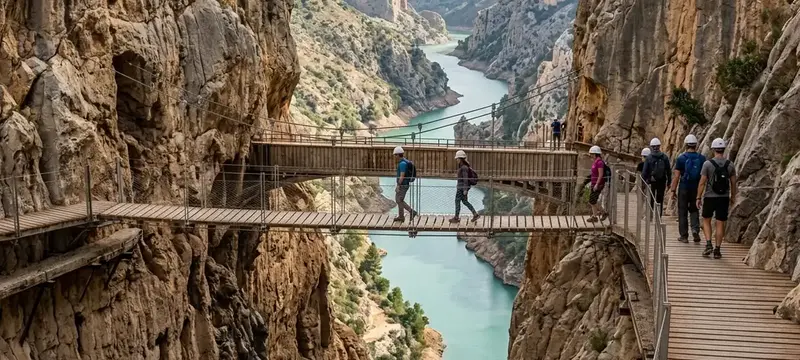
Caminito del Rey, a 7.7 km path bolted into a gorge 60 km north, is the strongest single day out and must be booked weeks ahead in spring and autumn. Ronda, Nerja and Frigiliana are all within about 90 minutes and are a complete change of pace – the day trips guide covers how to reach each one.
Two full days cover the Big Three, Soho, a couple of museums, the market and an evening in Pedregalejo. Three days let you add one of the above. The 3-day itinerary sequences it so you are never crossing the city twice.
FAQ – things to do in Málaga
Images: Olaf Tausch / Wikimedia Commons / CC BY 3.0
Reader Comments 💬
Share your experience or ask a question