
AEMET's climate normals for Málaga Airport give the city 2,905 hours of sunshine a year, an annual mean of 18.5°C and 534mm of rain across 42.3 days. That last pair matters most: it leaves roughly 323 days a year with no measurable rain. The question was never whether the weather here is good, but which kind of good you are booking for.
The whole year, as AEMET records it
These are the official normals for the Málaga Airport station (6155A), reference period 1981–2010. They are the closest thing to an official Málaga climate that exists, and they are the source for every figure on this page.
| Month | Mean °C | Avg max °C | Avg min °C | Rain mm | Rain days | Sunshine hrs | Humidity % |
|---|---|---|---|---|---|---|---|
| January | 12.1 | 16.8 | 7.4 | 69 | 5.8 | 180 | 69 |
| February | 12.9 | 17.7 | 8.2 | 60 | 4.8 | 180 | 68 |
| March | 14.7 | 19.6 | 9.8 | 52 | 4.0 | 222 | 67 |
| April | 16.3 | 21.4 | 11.1 | 44 | 4.5 | 244 | 63 |
| May | 19.3 | 24.3 | 14.2 | 20 | 3.1 | 292 | 59 |
| June | 23.0 | 28.1 | 18.0 | 6 | 0.8 | 329 | 58 |
| July | 25.5 | 30.5 | 20.5 | 0 | 0.1 | 347 | 58 |
| August | 26.0 | 30.8 | 21.1 | 6 | 0.5 | 316 | 61 |
| September | 23.5 | 28.2 | 18.8 | 20 | 2.1 | 255 | 65 |
| October | 19.5 | 24.1 | 15.0 | 57 | 4.4 | 215 | 70 |
| November | 15.7 | 20.1 | 11.3 | 100 | 5.6 | 172 | 71 |
| December | 13.2 | 17.5 | 8.9 | 100 | 6.6 | 160 | 72 |
| Year | 18.5 | 23.3 | 13.7 | 534 | 42.3 | 2,905 | 65 |
Three things fall out of that table that no summary paragraph usually mentions. July is the sunniest month at 347 hours, not August – August loses 31 hours to late-summer haze and the occasional storm.
November and December are the wettest months at 100mm each, not January, which sits well behind them at 69mm. And July averages 0mm of rain across the whole month, with measurable rain on 0.1 days, the single most extreme figure in the dataset.
For what is happening outside right now rather than what happens on average, the live Málaga forecast is the page you want. Everything below is the long-run record.
Why these numbers are lower than the ones you have been reading
If you have compared a few Málaga weather pages, you will have noticed they broadly agree with each other and disagree with the table above. This page was one of them until today: it quoted 32°C for July and August, and AEMET's figures are 30.5°C and 30.8°C.
The gap is not a different dataset. It is rounding, applied one step at a time and always in the same direction. A 30.8°C average maximum becomes "31°C", which becomes "low thirties", which becomes "32°C" by the time it has been copied twice. The same thing happens to January's 16.8°C, which is published almost everywhere as a clean 17°C.
The "300 days of sunshine" line has a similar history. AEMET does not publish a count of sunny days for Málaga at all – it publishes hours, 2,905 of them a year, which averages just under eight hours a day.
The rain column is what rescues the claim. Measurable rain falls on 42.3 days, so about 323 days stay dry – a defensible version of the same idea, drawn from the dataset rather than from a tourist board.
The sea, which no official body measures
AEMET publishes no sea surface temperature for Málaga. Every sea figure you see on any Costa del Sol page, including this one, comes from commercial aggregators that each run slightly different models, which is why they never quite match.
Read as a range rather than a number, they agree on the shape of the year:
- December to February: around 14–16°C. Cold, and not a lifeguarded swimming season.
- March to May: 16°C at the start, rising to 18–20°C by late May. The threshold most swimmers cross somewhere in May.
- June to September: 22–26°C, peaking in August. Warm enough that entering the water stops being a decision.
- October to November: 21–23°C in early autumn, dropping steadily after. October is the last genuinely warm month.
The practical version: the water warms and cools more slowly than the air, and the clearest illustration is a pair of months with nearly identical afternoons. May averages a 24.3°C daily maximum and October 24.1°C – two-tenths of a degree apart. The sea in May is 18–20°C; in October it is 21–23°C. Same afternoon on land, a different swim entirely, which is the single most useful thing to know when picking a beach month.
What each season actually delivers
The seasonal averages below are worked out from the monthly table above, using the groupings this site uses throughout.
| Season | Months | Avg max | Rain | Rain days | What it is for |
|---|---|---|---|---|---|
| Spring | Mar–May | 21.8°C | 116mm | 11.6 | Walking, day trips, monuments |
| Summer | Jun–Sep | 29.4°C | 32mm | 3.5 | Sea, late nights, festivals |
| Autumn | Oct–Nov | 22.1°C | 157mm | 10.0 | Value, warm water, hiking |
| Winter | Dec–Feb | 17.3°C | 229mm | 17.2 | Culture, prices, empty streets |
Spring is the season that does the most things at once. By April the average maximum is 21.4°C with 244 hours of sun, which is enough for all-day sightseeing without the shade-management that summer requires, and the inland country is still green from winter rain. The catch is that the sea has not caught up, and that Semana Santa lands somewhere inside it.
Summer is a genuinely different climate rather than a warmer version of spring. Four months carry 3.5 rain days between them, the sea reaches its annual peak, and the city shifts its whole day: outdoors before 11:00, indoors or in the water through the afternoon, back outside from 17:00. It is also the most expensive and most crowded stretch of the year by a wide margin. If sightseeing on foot is the point of the trip, this is the wrong season and the numbers say so.
Autumn is the most underrated part of the Málaga year. October holds a 24.1°C average maximum and a sea still around 21–23°C, with the summer crowds gone and accommodation back to sensible money. The trade-off arrives with November, which brings 100mm of rain – the joint wettest month – while still averaging 20.1°C in the afternoon. This is the season for hiking and the inland day trips, when the light is long and the hills are not baked.
Winter is mild rather than warm, and the gap between afternoon and night is the thing that catches people out. A 17.3°C average maximum is comfortable walking weather in direct sun; the same day after dark is a 7–9°C evening that wants a real coat. Rain is at its heaviest of the year, but it tends to arrive in short bursts with clear sky either side rather than as all-day grey. Prices are at their annual floor and the monuments have no queues at all.
Best time to visit, by what you came for
There is no bad month here, which makes "when should I go" the wrong question. The useful one is what you would be annoyed to miss.
| What you came for | Go in | Why | The trade-off |
|---|---|---|---|
| Swimming | Aug–Sep | Sea at its annual peak, 22–26°C | August is peak price and peak crowd |
| Sightseeing on foot | Apr–May, Oct | 21–24°C, long days, no heat management | Sea still cool in April and May |
| Walking and hiking | Mar–May, Oct–Nov | Green country, comfortable temperatures | November is the joint wettest month |
| Lowest prices | Nov–Feb | Accommodation at its annual floor | Short days, most rain, cool sea |
| Maximum sunshine | Jun–Jul | 329 and 347 hours, near-zero rain | Heat restricts the middle of the day |
| The big festivals | Mar/Apr, Aug | Semana Santa and the Feria | The two busiest weeks of the year |
If you want one answer rather than a matrix: May and October are the two months that ask you to give up the least.
May gives 24.3°C, 292 hours of sun and 3.1 rain days, with the sea just about crossing into swimmable and the summer prices not yet applied. October gives 24.1°C and the warmest water of any month outside high summer, with the crowds already gone. Both let you walk all day and still swim.
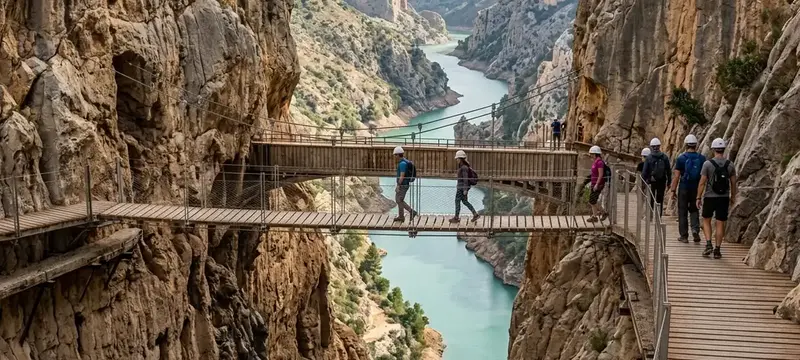
The honest counterweight is that these are also the months every other guide recommends, which shows up at the ticket desk rather than in the weather. Caminito del Rey slots and Alhambra tickets go weeks ahead through spring and autumn.
So the sequence is: fix your dates, book the timed attractions, then book the room. The neighbourhood guide covers where that room should be, and the packing list changes far more between these months than the temperature column suggests.
The two weeks that override the weather
Two fixed points in the calendar matter more than any temperature on this page, because they change availability and price rather than conditions.
Semana Santa moves with Easter. In 2026 it ran from 29 March to 5 April, with nine brotherhoods processing on Palm Sunday alone and about 45 processions across the week. Easter Sunday falls on 28 March in 2027, which puts Holy Week in the second half of March that year. Málaga's processions are among the most elaborate in Andalusia, and the city is at its fullest and most expensive for them.
Feria de Málaga is fixed to mid-August. The 2026 fair runs 15 to 22 August, eight days, confirmed by the Ayuntamiento. It is the biggest week of the Málaga year and the hardest one in which to find a central bed.
Both dates move, and only one of them is announced far ahead
Every month in detail
Each month has its own page with the full AEMET breakdown, what is on, and what to pack.
- January – the bottom of the table on temperature and the bottom of the market on price. It is the month for monuments without queues and restaurant tables without booking, and the Three Kings parade on 5 January closes the Spanish Christmas properly.
- February – a degree warmer than January with the same low prices, almond blossom in the hills, and the Day of Andalusia on 28 February.
- March – 222 hours of sun and the first month that feels like it is turning. Semana Santa may land at the end of it.
- April – 21.4°C and 244 hours of sun, the month sightseeing works best and the sea still does not.
- May – 24.3°C, 292 hours of sun, 3.1 rain days. The most recommended month here, and it earns it.
- June – 329 hours of sun and the sea crossing 22°C. Summer without the August pricing.
- July – the sunniest and driest month on record: 347 hours, 0mm, 0.1 rain days.
- August – the hottest month at 30.8°C, the warmest sea, and the Feria inside it.
- September – August conditions with the crowds gone. Arguably the best beach month of the year.
- October – 24.1°C with water still in the low twenties, and the best hiking of the year.
- November – 20.1°C afternoons against 100mm of rain, and the lowest prices before Christmas.
- December – 17.5°C days, 8.9°C nights, and the Calle Larios lights.
FAQ – Málaga weather and the best time to visit
Images: Diego Delso / Wikimedia Commons / CC BY-SA 4.0
Reader Comments 💬
Share your experience or ask a question