
AEMET's normals for Málaga Airport give August an average daily maximum of 30.8°C, an average daily minimum of 21.1°C, 6mm of rain and 316 hours of sunshine. The other number shaping the month is not a weather figure: Feria de Málaga 2026 runs 15 to 22 August, confirmed by the Ayuntamiento. That is what separates this August from an ordinary one – the same heat, with the whole city out in it for eight days.
The numbers, and where the round ones come from
These are AEMET's own normals for Málaga Airport, which is the closest thing to an official August for this city.
| Measure | August normal |
|---|---|
| Mean temperature | 26.0°C |
| Average daily maximum | 30.8°C |
| Average daily minimum | 21.1°C |
| Monthly rainfall | 6 mm |
| Days with measurable rain | 0.5 |
| Monthly sunshine | 316 hours |
| Mean relative humidity | 61% |
If you have been comparing pages, you will have seen 31°C highs, 22°C lows and 11 hours of sun quoted almost everywhere, including on this page until today. Those are the AEMET figures rounded up a step at a time, and the rounding always goes the same direction. The honest version is 30.8°C and 21.1°C, and 316 hours divided across thirty-one days rather than a daily figure anyone publishes.
The sea is the one number nobody can settle. Three separate long-term datasets put Málaga's August sea surface temperature at 23.4°C, 23.5°C and 24.0°C, with individual days recorded anywhere from 18.6°C to 27.7°C. AEMET publishes no official sea figure at all. So the useful reading is mid-twenties: warm enough that entering the water is not a decision, and not warm enough to be the bathwater some listings promise.
The rain line deserves one sentence of its own, because 0.5 days is easy to skim past. It means that in an average August it does not rain at all, and roughly every second year one brief storm passes through. Planning around rain here is planning around nothing.
Feria de Málaga runs 15 to 22 August in 2026
This page used to say the Feria "may fall in July or August depending on the year, check the dates." It does not need hedging any more. The Ayuntamiento de Málaga has confirmed the 2026 fair for 15 to 22 August inclusive, eight days, with the fireworks that traditionally open it on the night of 14 August.
That matters more than any temperature on this page. For eight days the city stops being a place you sightsee and becomes a place that is having a party, with the crowd, the noise and the pricing that go with it.
If the Feria is why you are coming, this is the best week of the Málaga year. If you were planning a quiet architectural weekend, it is the worst one, and the two are eight days apart.
The practical consequence is accommodation. Central rooms for Feria week are the hardest beds to find in the Málaga calendar, and they do not get cheaper as the date approaches. Book them a long way out or stay outside the centre and travel in – the neighbourhood guide covers which areas are far enough to sleep and near enough to get back from.
What 40°C actually means here, and how often it happens
The 30.8°C average is not the number that ruins an afternoon. The number that does is what happens when hot air arrives from North Africa and sits over the city for a couple of days, and this is a recurring pattern rather than a freak event.
AEMET issued a formal heatwave warning – special adverse-phenomena notice 26/2026 – running from Wednesday 29 July to at least Sunday 2 August 2026, with maximums above 40°C across large parts of Spain. That is the shape of the thing: not a whole month at 40°C, but a short, announced, well-forecast spell that lands once or twice a summer and is genuinely different from an ordinary hot day.
UV is the part visitors underestimate more than heat. Typical peak UV in Málaga in August sits around 10 to 11, and AEMET's own national forecast table has shown a maximum index of 10 for the city in high summer. That is the "very high" band, where unprotected fair skin burns in well under half an hour.
The shape of an August day
The city solves the heat by moving the day, and visitors who fight that arrangement have a worse time than visitors who copy it. The pattern is not a lifestyle observation, it is a timetable.
- Before 11:00: the only comfortable window for anything outdoors and uphill. Monuments, the old town, the walk up to the castle. Stone radiates heat by midday and the fortresses have very little shade on the route.
- 11:00 to 17:00: the beach, the sea, or somewhere air-conditioned. Museums earn their entry fee in August in a way they do not in March.
- 17:00 to 20:00: the city comes back out. Shade returns to the streets, the light gets good, and the promenade becomes usable again.
- From 21:00: dinner, and the part of August that off-season visitors never see. With a 21.1°C average minimum, the night does not cool down enough to send anyone home, so the streets stay busy very late.
Two things follow from this. Restaurant reservations matter far more than usual on August weekends, because everyone is eating in the same three-hour window. And the rooftop bars are worth booking rather than wandering into from about 20:00, for the same reason.
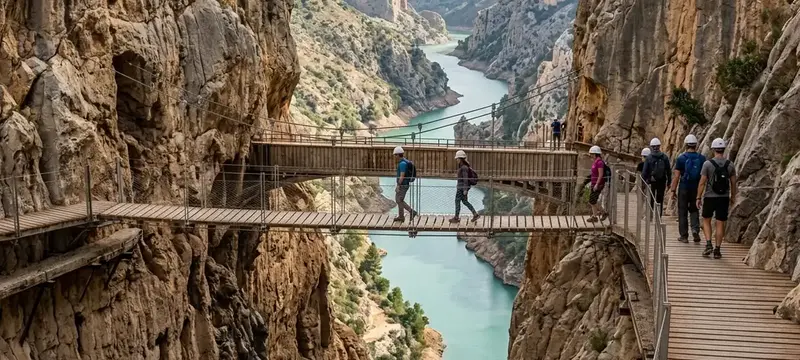
The day trips need the same discipline in a harsher form. Caminito del Rey in August is an exposed gorge walk with no shade and no early exit – take the first slot of the day or leave it for another trip.
What to pack
August packing is short, and the mistakes are all in the accessories rather than the clothes.
- The lightest fabrics you own: linen and loose cotton in pale colours. Synthetic fabrics that were fine in June are miserable at 30.8°C.
- A hat with an actual brim: a cap leaves your ears and neck exposed under a UV index of 10.
- SPF 50 and enough of it: you will use more than you expect, and it is cheaper at a Spanish supermarket than at a beach kiosk.
- Sunglasses that block UV rather than just tint: 316 hours of sun a month is a lot of glare off white walls and water.
- One long-sleeved layer: for air conditioning set aggressively low indoors, not for the outdoors.
- Shoes you can walk in wet: you will go from sea to street repeatedly, and flip-flops on hot polished stone are how people fall over.
- A refillable bottle: tap water is safe and free to refill, and buying bottled water at August prices adds up fast.
What August is genuinely good for
The sea, and only partly the beach. Mid-twenties water is the warmest it gets all year, and swimming in August here needs no acclimatisation at all – you walk in. The city beaches fill early on weekends, so the eastern stretches at Pedregalejo and El Palo are the better bet for space, and along the coast the Marbella beaches spread the same crowd across a lot more sand.
The nights are the other genuine argument, and the Feria is the extreme version of it. A city that stays out until 03:00 because it is too warm to go indoors is not something the shoulder season can reproduce.
What August is not good for is anything that involves standing in a queue in the sun, or any expectation of paying low-season prices. If the monuments and the old town are the reason for the trip rather than the sea, the month-by-month weather guide points at a window where you get the same city with 10°C less on it.
Reader Comments 💬
Share your experience or ask a question