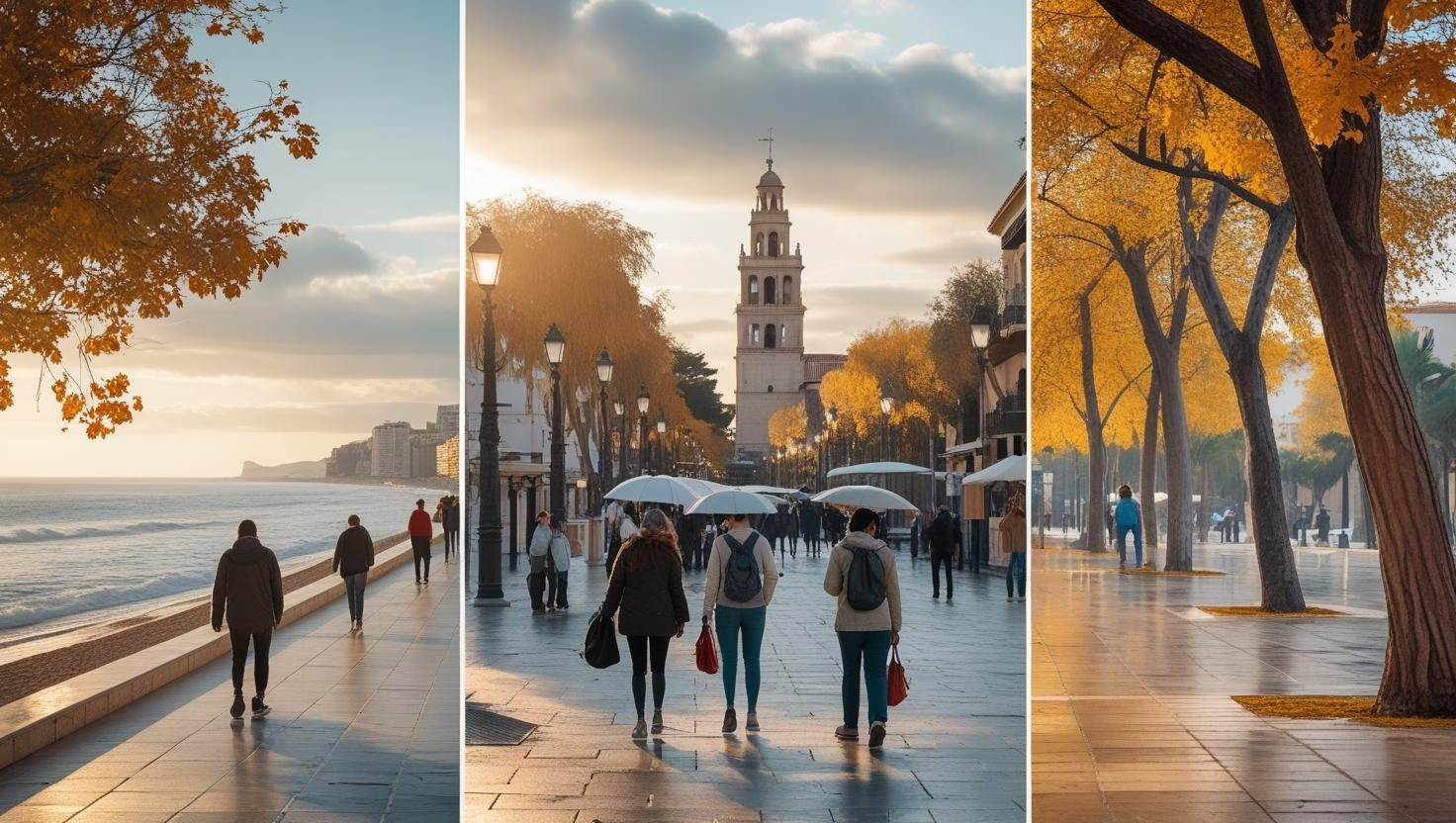
AEMET's climate normals give Málaga an average daily maximum of 20.1°C in November, an average minimum of 11.3°C and 172 hours of sunshine. That is a warm-jumper afternoon rather than a cold one, and it is roughly two degrees above the figure most travel pages quote, including this one until today.
The trade-off is written into the same dataset. November brings 100mm of rain across 5.6 days, which ties it with December as the wettest month of the Málaga year. Both facts are true at once, and the second is why the first is not more widely known.
What November actually looks like in the record
These are the official normals for the Málaga Airport station (6155A), reference period 1981–2010, with the months either side for context.
| October | November | December | |
|---|---|---|---|
| Mean °C | 19.5 | 15.7 | 13.2 |
| Average max °C | 24.1 | 20.1 | 17.5 |
| Average min °C | 15.0 | 11.3 | 8.9 |
| Rain mm | 57 | 100 | 100 |
| Rain days | 4.4 | 5.6 | 6.6 |
| Sunshine hrs | 215 | 172 | 160 |
| Humidity % | 70 | 71 | 72 |
The shape of the month is a four-degree step down from October in the afternoon and nearly a doubling of the rain. What it is not is a step into winter: 20.1°C is still warmer than the annual average maximum of most of northern Europe in high summer.
Divided across thirty days, 172 hours works out at just under six hours of sunshine a day. AEMET publishes hours rather than sunny days, so treat that as a monthly total spread unevenly rather than a promise about any given afternoon.
Why this page said 18°C until today
Because it was copying the same rounded number everyone else copies, and the site's own Málaga weather by month guide has said 20.1°C since it was rebuilt from the AEMET normals.
That is a two-degree gap in the wrong direction, and two degrees is the difference between a jacket and a coat when you are packing. It matters more in November than it would in July, because 18°C reads as a day you plan indoors and 20.1°C reads as a day you plan on foot.
The correction runs the other way from the usual one. Most Málaga weather errors round summer temperatures up – 30.8°C becomes "low thirties" becomes 32°C. November got rounded down instead, probably because "18°C in November" fits the story people expect of a Mediterranean off-season.
Does it rain a lot in Málaga in November?
More than in any month except December, and the two are level. 100mm falls across 5.6 days, which is the useful way to read it: a large volume of water arriving on relatively few days rather than a persistent grey month.
That distribution is what makes the month workable. Roughly 24 days in an average November record no measurable rain at all, and the rain that does arrive tends to come in short heavy bursts with clear sky either side rather than as all-day drizzle.
The planning consequence is about flexibility, not waterproofs. Book the indoor things loosely and keep them as the wet-morning fallback, rather than fixing a museum to a specific day.
Can you swim in Málaga in November?
Not comfortably, and no official body will tell you the temperature either way. AEMET publishes no sea surface temperature for Málaga at all, so every figure on every site comes from commercial aggregators running different models.
Read as a range, they put November somewhere around 18–20°C, falling through the month from October's warmer water. That is swimmable for the hardy and short, and it is not a beach-holiday sea. The beaches themselves are effectively empty, which is worth the walk regardless.
The Christmas lights, and the date nobody has announced yet
The Calle Larios switch-on is the one November event worth building a trip around, and the city treats it as the start of the season rather than a December event.
The pattern is consistent: the lights went on Friday 29 November 2024 at 18:30, and Friday 28 November 2025 at 18:30 – the last Friday of the month both years, with a performance on the hour repeated through the evening.
No 2026 date has been published as of August 2026. Going by the pattern it would fall on the last Friday of November, but the Ayuntamiento confirms it in the autumn and this page is not going to invent a date. If it decides your dates, check the city's own calendar in October.
The switch-on itself draws a crowd that fills the street end to end. If you want photographs rather than a scrum, go back on a weeknight afterwards, when the same display runs from 18:30 with a fraction of the people.
What November is genuinely best for
This is the month sightseeing works without any of the management summer demands. No heat to plan around, no queue at the Alcazaba, no negotiating for a restaurant table.
- Monuments and museums: comfortable temperatures and low-angle light, with the shortest queues of the year
- Walking and hiking: the Montes de Málaga hold colour and the trails are cool enough to walk at midday
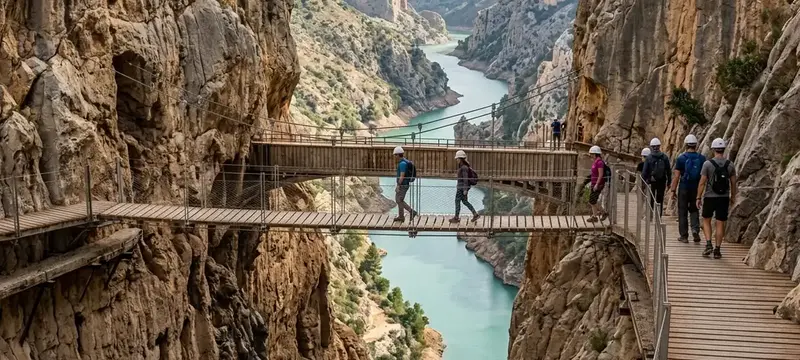
- Caminito del Rey: the easiest month of the year to get a slot, though it still needs booking ahead
- Day trips: Ronda in autumn light is the pick, and the inland roads are empty
- Prices: the annual floor for flights and accommodation before the Christmas rates apply
The neighbourhood guide is worth reading properly for a November trip, because the calculation changes: with no beach season, being walkable to the old town matters more than being walkable to the sand.
What to pack for 20°C days and 11°C nights
The nine-degree spread between afternoon and night is the thing that catches people, not the headline temperature.
- Layers rather than weight: a long-sleeved top and a jumper cover most days better than one thick garment
- A mid-weight waterproof jacket: the single most useful item in the bag
- Shoes with grip: Málaga's marble and cobbled streets are genuinely slippery wet
- A compact umbrella: the showers arrive fast and pass fast
- Something warm for evenings: 11.3°C at 71% humidity feels colder than the number
What you can leave at home is a winter coat and anything you would only wear on a beach.
November conditions turn over faster than the monthly averages suggest, and a bright morning can be a wet, windy afternoon by 15:00. Check AEMET's Málaga forecast the evening before rather than planning a fixed week in advance.
November against October and December
The three autumn months are not variations of each other, and the honest comparison comes down to what you give up.
October keeps 24.1°C afternoons, the warmest sea outside high summer at roughly 21–23°C, and only 57mm of rain. It is the better month by conditions, and it costs more and holds more people. If the sea matters at all, take October instead.
December loses another 2.6°C in the afternoon, gains a rain day and drops to 160 hours of sun, but arrives with the Christmas lights running all month and the city at its most atmospheric.
November sits in the gap on purpose. It is the cheapest and emptiest of the three, warm enough to walk all day, and it catches the lights in its final week. What it gives up is the swimming and the guarantee of dry weather.
Reader Comments 💬
Share your experience or ask a question