
AEMET's normals for Málaga Airport give March an average daily maximum of 19.6°C, an average daily minimum of 9.8°C, 52mm of rain across 4.0 days and 222 hours of sunshine. Two of those deserve more attention than the temperature. March has the fewest wet days of any month from October through March, and its 222 sunshine hours are 42 more than February's – the largest month-on-month gain in the first half of the year.
The numbers, and the ones this page had wrong
These are AEMET's normals for Málaga Airport, station 6155A, reference period 1981–2010, the same record behind the month-by-month weather guide.
| Measure | March normal | This page previously said |
|---|---|---|
| Mean temperature | 14.7°C | not stated |
| Average daily maximum | 19.6°C | 19°C |
| Average daily minimum | 9.8°C | 11°C |
| Monthly rainfall | 52 mm | 50–60mm |
| Days with measurable rain | 4.0 | 5–6 |
| Monthly sunshine | 222 hours | 6–7 hrs/day |
| Mean relative humidity | 67% | not stated |
Two of those were meaningfully wrong rather than rounded. The overnight low is 9.8°C, not 11°C – a degree and a bit colder than this page claimed, and enough to change what you pack for the evening. And March averages 4.0 wet days, not five or six, which overstated the rain risk by up to fifty per cent on the field visitors actually plan around.
The sunshine figure was understated in the other direction. 222 hours across 31 days is about 7.2 a day, not the six to seven this page used to print.
Sea temperature is the number nobody can settle, because AEMET publishes no sea surface temperature at all. Commercial models put the Málaga sea around 16°C in March – its annual floor, because the water lags the air by roughly two months and is still catching up with January. Bright promenade, cold water.
Semana Santa 2027 runs 21 to 28 March
Easter moves, and it moves March more than it moves any other month. In 2027 Holy Week runs from Palm Sunday on 21 March to Easter Sunday on 28 March, which puts the entire thing inside March and leaves April clear of it.
That single fact splits the month in two, and the two halves are not comparable trips.
Outside Holy Week, March is arguably the best-value window in the Málaga year. You get spring conditions – 19.6°C afternoons, four wet days, 7.2 hours of sun – at accommodation prices closer to January than to April.
During Holy Week, central Málaga is the most expensive it gets outside high summer. Hotels in the historic centre sell out months ahead, prices climb sharply, and the streets on the main procession routes become genuinely impassable for hours at a time.
The processions themselves are free to watch. The brotherhoods carry enormous decorated floats through the centre across the week, with the most dramatic on the Thursday and Friday nights, and a good position on Calle Larios means arriving an hour or two early.
The Agrupación de Cofradías publishes the full route and timing schedule ahead of the week. Planning your days around it beats discovering a street is closed while standing in it.
What the range actually looks like
The 19.6°C average is a genuine average of two quite different fortnights, and March has more internal spread than any other month here.
Early March can still produce cold, blustery days that feel closer to 14°C than to 19.6°C. By the last week, afternoons in the low twenties and outdoor dinners without a jacket are routine. Anyone booking on the strength of the monthly figure alone should know which half of the month they are buying.
The overnight figure does not move nearly as much, and 9.8°C after dark is the constant across both halves. That is the number that catches people who packed for the afternoon.
What March is genuinely good for
Everything that is uncomfortable in July. The climb to Gibralfaro and the old town on foot are at close to ideal temperature, and the queues that define the summer months have not formed.
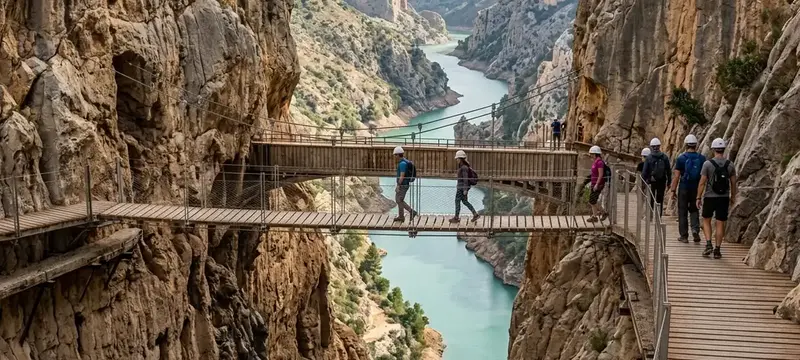
It is also the best month of the year for the inland day trips, before the heat makes them a management exercise. Ronda in March light has sharp gorge views and a quiet town, and the Caminito del Rey is in its prime season with wildflowers in the gorge and slots that are easier to secure than April's or May's – though "easier" is relative, and it still sells out well ahead.
What March is not is a beach month. Sixteen-degree water is for walking beside, not swimming in, and the first genuinely swimmable sea arrives around late May.
What to pack
- Layers with real range: the month spans a cold early fortnight and a warm late one.
- A proper waterproof, not just an umbrella: March showers are heavier than February's when they come, even though they come on fewer days.
- An evening layer you will actually use: 9.8°C after a 20°C afternoon feels colder than 9.8°C does in January.
- Shoes with grip: wet polished stone in the old town is the most common minor mishap of the season.
- Sunglasses: 7.2 hours a day of strengthening spring sun.
Reader Comments 💬
Share your experience or ask a question