Ronda sits about 100 km inland from Málaga, and reaching it is genuinely easy: roughly seven buses a day from around €12, or an hour and a half in a hire car. Getting there was never the hard part.
What actually shapes the day is Setenil de las Bodegas, the village built underneath rock overhangs 20 minutes further on. No timetable gets you both towns and back to the coast in one day, which is why the cheap bus and the guided coach answer two different questions. Every price here was checked on 21 July 2026.
Málaga to Ronda: four routes, honestly compared
Times are city to city. The bus and train both leave from the same corner of Málaga – the Estación de Autobuses sits directly behind María Zambrano station.
| Route | Time each way | Cost | The catch |
|---|---|---|---|
| Bus | 1h30–2h30 | from ~€12 | Ronda only, and you must book the return |
| Train | 2h10–2h30 | from ~€16 | one change, four a day, slower than the bus |
| Car | ~1h30 | fuel + €22.25 parking | you drive the mountain road both ways |
| Guided tour | 9h round trip | €28 | fixed timings – but it includes Setenil |
By bus. Three operators share the corridor – Avanza, Interbus and Autocares Sierra de las Nieves – for about seven departures a day between them. Fares start around €12 and journeys run from 1h30 to over three hours, depending on how many villages the service stops at, so read the duration before you read the price. Avanza's own direct L-304 leaves Málaga at 08:00 and 09:15 and returns from Ronda at 15:00, 16:15 and 18:35. That 08:00 out, 18:35 back pairing is the whole day trip in two bookings, and with only three services home it is worth buying the return at the same time.
By train. There is no direct service. Renfe runs about four a day with a change at Antequera-Santa Ana, 2h10 to 2h30, from roughly €16 booked ahead and considerably more on the day. It is slower than the bus, usually dearer and far less frequent, so take it only if you would rather sit on a train than a coach. The genuinely spectacular stretch of this railway is Ronda to Algeciras, which is not the section you ride from Málaga.
By car. Two routes, and they are not equivalent. The A-357 then A-367 runs inland in about 1h30 and passes the El Chorro turn-off, which is why people pair Ronda with Caminito del Rey across two days. The A-397 climbs from San Pedro de Alcántara through cork oak and switchbacks – slower, and one of the best drives in Andalusia. Park underground at Plaza del Socorro, 100 m from the bridge: €3.05 an hour, capped at €22.25 for the full day.
By tour. One departure, one fixed shape to the day, and the only version of this trip that puts Setenil in it without a hire car. More on why that matters below.
Now the part that decides it. Work down until a line describes you.
- If you want Ronda and Setenil, and you are not hiring a car
The guided day trip is the only realistic way to do both.
Nine hours from central Málaga, coach both ways, free time in Ronda and about an hour under the rock in Setenil, with a little tourist train and an optional wine and tapas stop. At €28 it undercuts most Ronda coach tours by half, and it cancels free up to 24 hours before – so you can book it now and still change your mind.
Check tour availability - If Ronda on its own is enough for you
Take the bus and keep the €16 difference.
Ronda is a compact, walkable town and everything worth seeing sits within 20 minutes on foot of the bridge. The 08:00 coach puts you there before the tour groups and the 18:35 gets you back for dinner in Málaga. Buy both legs at avanzabus.com or at the station counter.
- If you want both towns, your own timings and the mountain road
Hire a car – Setenil is 20 minutes past Ronda.
The pair works properly by car: Ronda in the morning, Setenil after lunch when the low sun reaches under the overhangs, and back down the A-397 in the evening. Budget €22.25 for a full day in the Plaza del Socorro car park.
Compare car hire prices - If you are staying on the western Costa del Sol, not in Málaga
Start from Marbella instead – it is half the distance.
From Marbella or Estepona the A-397 gets you to Ronda in about 45 minutes, which changes the maths on tours, pickups and how long you can stay.
Ronda from Marbella
The one ticket to book before you leave Málaga
Ronda has no timed-entry bottleneck the way Granada or Caminito del Rey do. You can turn up, walk the bridge and buy everything else at the door. There is exactly one exception.
The Desfiladero del Tajo is the path that opened in 2024 down the side of the gorge to the foot of the Puente Nuevo. Standing under 98 metres of masonry and looking up at it is a different sight from anything on the rim, and it is the single thing people regret missing. Entry is €5 flat, capacity is small and the ticketing sells in dated slots.
Book it online, and check the season
Allow around 20 minutes at the bottom and the same again on the steps in each direction. The descent is steep and uneven; this is the part of Ronda that rules itself out if anyone in your group struggles with stairs.
What Ronda costs once you are there
The town's headline sight is free. Walking the Puente Nuevo, standing on it and photographing it from the Mirador de Aldehuela or the path down to the Mirador de Cuenca costs nothing at all – which is worth saying, because a lot of pages imply otherwise.
| What | Price | Worth knowing |
|---|---|---|
| Puente Nuevo and the viewpoints | Free | Always open |
| Desfiladero del Tajo | €5 | Book ahead, seasonal hours, no under-8s |
| Plaza de Toros and Museo Taurino | €9 | Around €11 with the audioguide |
| Baños Árabes | €4.50 | €3 reduced |
| Palacio de Mondragón | €4 | €3 reduced |
| Bono Turístico | €12 | €9 reduced – covers four municipal sites |
The Bono Turístico maths is simple. It covers the Puente Nuevo interpretation centre, Casa del Gigante, the Baños Árabes and the Palacio de Mondragón, with the Convento de Santo Domingo and the Museo Joaquín Peinado thrown in when space allows.
Two of those sites alone come to €8.50, so the pass only pays if you genuinely intend to go inside three or more. On a day trip with a 15:00 bus to catch, most people do not.
The Plaza de Toros, built in 1784 and one of the oldest in Spain, is the paid visit that most reliably justifies itself. Nine euros buys the arena floor, the stone arcades and the museum, and an empty bullring in the middle of a weekday is unexpectedly quiet. The Baños Árabes are the best-preserved Moorish baths in Spain and take 20 minutes.
Everything else in La Ciudad, the old town on the south side of the gorge, is free to wander: white lanes, the Iglesia de Santa María la Mayor built over the main mosque, and almost no souvenir shops once you are three streets in.
Setenil de las Bodegas, and why it needs a car or a tour
Setenil is 20 to 30 minutes from Ronda by road and looks like nowhere else in Andalusia. Two streets – Calle Cuevas del Sol and Calle Cuevas de la Sombra – run directly beneath an overhanging cliff, so the rock is the ceiling of the bars and the roof of the houses at the same time. Ninety minutes covers it comfortably.
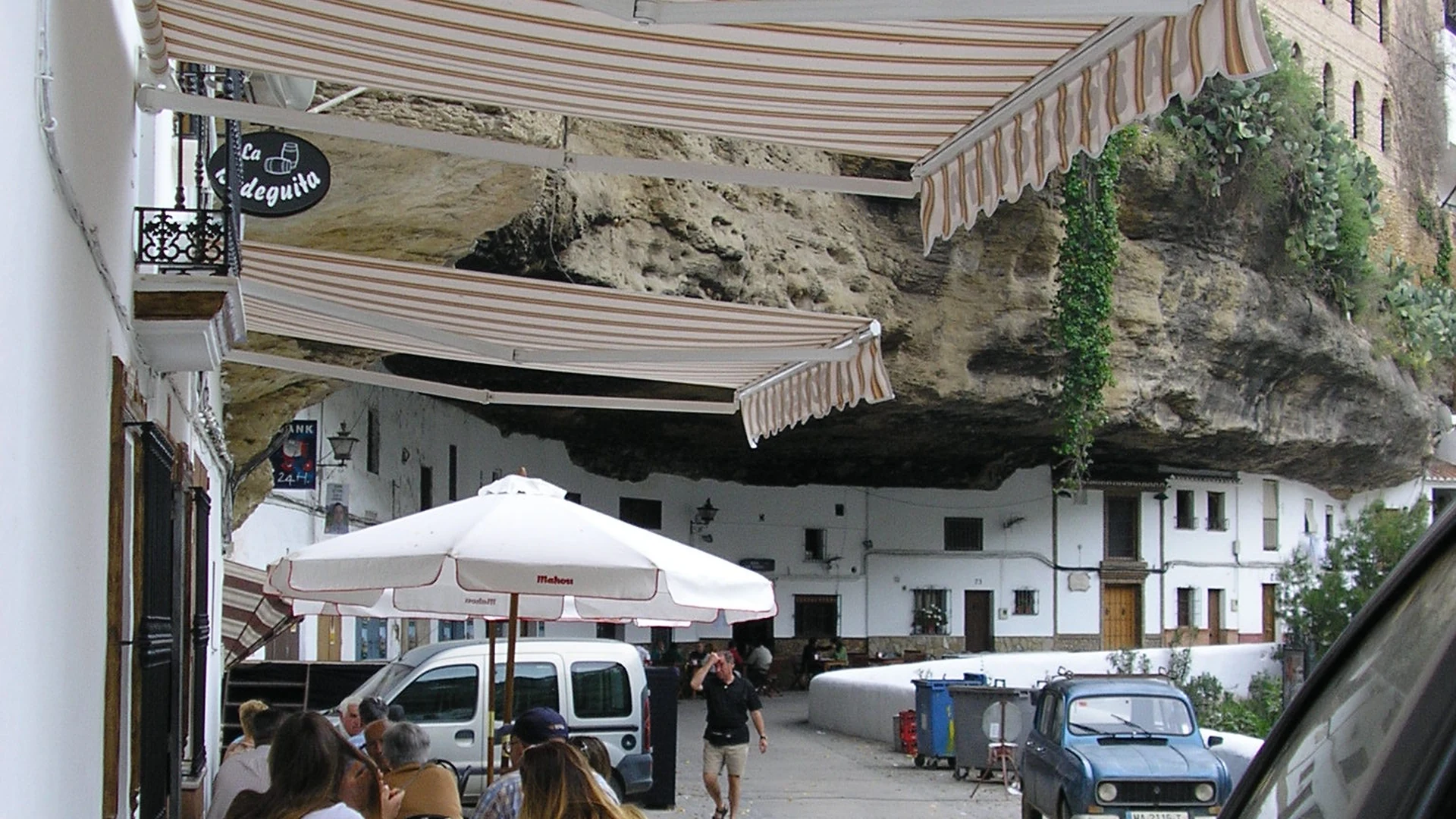
Here is the honest logistics problem. Local buses do run between Ronda and Setenil, operated by small regional companies, but the services are sparse, some do not run at weekends, and they were built for residents rather than visitors.
Chaining Málaga to Ronda to Setenil and back into a single day on public timetables leaves you either with 40 minutes in the village or stranded in it. That is not a sales pitch – it is the one place on this trip where paying for the tour buys something the bus genuinely cannot.
If Setenil is the part you actually came for, the full Setenil de las Bodegas guide covers the village on its own terms.
A day in Ronda, hour by hour
This is the independent version by bus, built around the real Avanza timetable. Shift everything an hour earlier if you are driving.
- 108:00
Coach from Málaga
Avanza L-304 from the Estación de Autobuses. Return booked for 18:35 at the same time – there are only three services back.
- 209:30
Arrive Ronda, coffee on Plaza del Socorro
The bus station is a 10-minute walk from the bridge, mostly downhill. The viewpoints are still quiet at this hour.
- 310:00
Puente Nuevo and the Mirador de Cuenca
Walk the bridge, then take Calle Los Remedios down to the Mirador de Cuenca for the full span against the cliff. Step 20 metres away from the crowd for a clean shot.
- 410:45
Desfiladero del Tajo
Your pre-booked slot. Down the steps to the base of the bridge, 20 minutes at the bottom, back up. Good shoes, and water in summer.
- 512:00
Plaza de Toros
€9 for the arena and the Museo Taurino. Around an hour, and it is indoors when the midday heat arrives.
- 613:30
Rabo de toro
Ronda's dish is bull's tail braised slowly in red wine. The places on Calle Espinel and around Plaza del Socorro serve it without tourist pricing – roughly €20 to €30 with a glass of Serranía red.
- 715:00
La Ciudad on foot
Across the bridge into the old town: Baños Árabes (€4.50), Palacio de Mondragón (€4), Santa María la Mayor, and lanes that empty out completely once the coaches leave at four.
- 817:30
Back to the rim for the light
The bridge takes low sun better than anything else in the town, and by now the viewpoints have thinned out.
- 918:35
Coach back to Málaga
Ronda sits at 700 m, so evenings run 5 to 8°C cooler than the coast even in August. Take a layer.
The tour day is shaped differently: departure from central Málaga in the morning, guided time and free time in Ronda through the middle of the day, then Setenil in the afternoon and back to the coast for the evening. You trade the ability to linger for the second town.
Wine is the other thing Ronda does properly. The Serranía sits at 700 to 900 metres and its bodegas produce reds that barely leave Andalusia – if that is the draw rather than the bridge, a dedicated Ronda wine tour visits the vineyards instead of driving past them.
When to go, and how to stay ahead of the coaches
The rhythm of Ronda is completely predictable. Organised coaches from Málaga, Marbella and the cruise terminal arrive between 10:30 and 11:30 and leave around 16:00. Inside that window the Mirador de Cuenca is several people deep and the bullring queue reaches the street; outside it, you can have the same viewpoints almost to yourself. Arriving on the 08:00 bus puts you an hour and a half ahead of that wave.
April to early June and September to October are the best months: warm, clear and with the Serranía still green in spring. July and August are hot, but the altitude means Ronda is meaningfully cooler than the beach – a real reason to come inland on a 34°C day. Winter is quiet and can be genuinely cold, and the Desfiladero closes at 17:00.
One week to plan around: the Feria y Fiestas de Pedro Romero runs 1–6 September 2026, and after two years of restoration work the bullring is hosting its full programme again, including the Corrida Goyesca. The town is at its best and its busiest, but sightseeing access to the Plaza de Toros is normally restricted around bullfight days. If the bullring is the reason you are going, check rmcr.org before fixing that date.
Andalusia keeps going beyond this one: Granada and the Alhambra is the other great inland day out, and the day trips guide ranks everything else worth leaving the coast for.
FAQ – Ronda day trip from Málaga
Images: Wolfgang Moroder / Wikimedia Commons / CC BY-SA 3.0