
AEMET's normals for Málaga Airport give July an average daily maximum of 30.5°C, an average daily minimum of 20.5°C, 347 hours of sunshine and 0mm of rain across 0.1 days. Those last two are the most extreme figures in the whole Málaga record: the sunniest month of the year, ahead of August, and the only one averaging no measurable rain at all. July is also not the month of the Feria.
The Feria de Málaga is in August, not July
This page previously stated that "in the second week of July, the Feria de Málaga takes over the entire city for eight days." That was wrong by a whole month, and it was wrong in the title, the description, the summary and three separate sections.
Feria de Málaga 2026 runs from 15 to 22 August inclusive, eight days, confirmed by the Ayuntamiento de Málaga, with the fireworks that traditionally open it on the night of 14 August. The fair's big day is Wednesday 19 August, a local public holiday marking the taking of the city in 1487. It is fixed to mid-August every year and has been for a very long time.
That correction improves July rather than damaging it. July is the month with August's heat and none of August's fair – nearly the same temperature, more sunshine, and without the eight days when central accommodation becomes the hardest to find all year.
If the Feria is what you want, the August page covers it and the week it takes over. If it is what you want to avoid, July is the answer.
The most extreme month in the record
These are AEMET's normals for Málaga Airport, station 6155A, reference period 1981–2010, the record behind the month-by-month weather guide.
| Measure | July normal | This page previously said |
|---|---|---|
| Mean temperature | 25.5°C | not stated |
| Average daily maximum | 30.5°C | 30°C |
| Average daily minimum | 20.5°C | 21°C |
| Monthly rainfall | 0 mm | 5–10 mm |
| Days with measurable rain | 0.1 | 0–1 |
| Monthly sunshine | 347 hours | 12 hrs/day |
| Mean relative humidity | 58% | not stated |
Two corrections matter. July averages 0mm of rain and 0.1 rain days – not the five to ten millimetres this page printed. Nought point one days means roughly one July in ten sees a single measurable shower, and the other nine see none. It is the driest figure in the entire dataset.
And 347 hours across 31 days is about 11.2 a day, not twelve. The rounded figure is generous by nearly an hour.
The sea is the number nobody can settle, because AEMET publishes no sea surface temperature. Commercial models put the Málaga sea in the low-to-mid twenties through July, climbing towards its August peak. It is warm enough that entering the water is not a decision, and it is not yet as warm as it gets.
What 30.5°C actually means on the ground
The average is not the number that ruins an afternoon. Individual July days run well above it, and when hot air arrives from North Africa the maximum can pass 40°C for a day or two – a recurring, well-forecast pattern rather than a freak event.
UV is the part visitors underestimate more than heat. Peak UV in Málaga in July sits around 10 to 11, the very high band, where unprotected fair skin burns in well under half an hour.
The overnight figure is the other thing northern Europeans misjudge. A 20.5°C average minimum means the city does not cool down at night, which is why the terraces and beach bars stay busy until two or three in the morning and why air conditioning matters more than a sea view when booking a room.
The shape of a July day
The city solves the heat by moving the day. Copying the timetable works far better than fighting it.
- Before 11:00: the only comfortable window for anything outdoors and uphill. Stone radiates heat by midday and the climb to the castle has very little shade on the route.
- 11:00 to 17:00: sea, or somewhere air-conditioned. The museums earn their entry fee in July in a way they do not in March.
- 17:00 to 20:00: shade returns to the streets and the light gets good. The promenade becomes usable again.
- From 21:00: dinner, and the part of July that off-season visitors never see. Sunset falls around 21:30 at the start of the month.
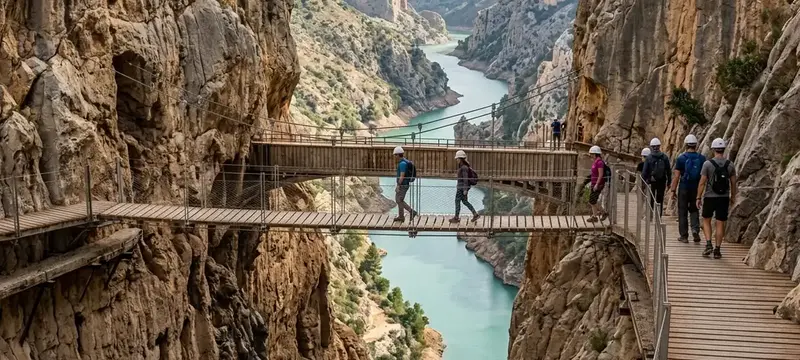
The day trips need the same discipline in a harsher form. The Caminito del Rey in July is an exposed gorge walk with no shade and no early exit – take the first slot of the day or leave it for a cooler month.
What to pack
- The lightest fabrics you own: linen and loose cotton in pale colours. Synthetics that were fine in April are miserable at 30.5°C.
- A hat with an actual brim: a cap leaves ears and neck exposed under a UV index of 10.
- SPF 50, and more than you think: cheaper at a Spanish supermarket than at a beach kiosk.
- One long-sleeved layer: for indoor air conditioning set aggressively low, not for outdoors.
- A refillable bottle: tap water is safe and free, and bottled water at July prices adds up fast.
- Shoes you can walk in wet: you will go from sea to street repeatedly.
What July is genuinely good for
The sea, the nights, and the certainty. Nought point one rain days is as close to a weather guarantee as travel planning gets – there is genuinely nothing to plan around.
The nights are the other real argument. A city that stays out past 02:00 because it is too warm to go indoors is not something the shoulder season reproduces, and the rooftop bars and late restaurants are running at full pace all month.
What July is not good for is queueing in the sun, sightseeing on foot in the afternoon, or paying low-season prices. If the monuments and the old town are the reason for the trip rather than the sea, the record points at spring or autumn for the same city with ten degrees less on it.
Reader Comments 💬
Share your experience or ask a question