
AEMET's climate normals give Málaga an average daily maximum of 30.5°C in July and 30.8°C in August – two to three degrees below the 33°C and 34°C that most summer pages print, this one included until today. The figure that matters more is the one those pages leave out entirely: the average overnight minimum is 20.5°C in July and 21.1°C in August, and that is what decides whether you sleep.
Everything below comes from the official normals for the Málaga Airport station, and from what those numbers do to an actual day in the city.
What a Málaga summer actually measures
| Month | Avg max °C | Avg min °C | Rain mm | Rain days | Sunshine hrs |
|---|---|---|---|---|---|
| June | 28.1 | 18.0 | 6 | 0.8 | 329 |
| July | 30.5 | 20.5 | 0 | 0.1 | 347 |
| August | 30.8 | 21.1 | 6 | 0.5 | 316 |
| September | 28.2 | 18.8 | 20 | 2.1 | 255 |
Two things in that table are not what people expect. July is the sunniest month of the year at 347 hours, not August – August gives up thirty of them to late-summer haze. And July averages no measurable rain at all, with rain falling on 0.1 days: the single most extreme figure in the whole Málaga record.
The averages also hide the days that get remembered. When hot air arrives from North Africa the maximum can pass 40°C for a day or two, and AEMET issues a formal heatwave warning for it.
Those spells are real, they usually land in late July or early August, and they are not what a 30.8°C average describes. The month-by-month detail is in the Málaga weather guide.
The nights are the part visitors underestimate
An afternoon at 30°C in dry air with a sea breeze is manageable, and most people cope with it better than they expect to. Two consecutive months of nights that do not drop below about 21°C are a different problem, and it is the one that ruins sleep in July and August.
This has a practical consequence when you book. Check that air conditioning is in the bedroom rather than in the living room of the apartment, and that it is included rather than metered – both are common enough here to be worth reading the listing for twice.
It also explains why the city eats at 21:00 and why the streets are busiest at 23:00. Nobody in Málaga is being romantic about late evenings: they are the only comfortable hours of a summer day, and the whole city has arranged itself around that fact.
The shape of a summer day here
Work with the rhythm and summer is excellent. Fight it and you spend the trip queueing in full sun.
- Before 11:00 – the monuments. The Alcazaba's uphill route turns into a sun-trap after about 11:00, and it opens at 09:00. This is also the quiet window before the cruise groups land.
- Roughly 12:00 to 17:00 – water or air conditioning. The beach, a pool, or the museums. The Picasso Museum opens every day including Monday, which makes it the reliable hot-afternoon answer.
- From 17:00 – back outside. The old town becomes usable again, the light improves, and terraces start filling.
- From 21:00 – dinner. Kitchens are still serving at 23:00 and later.
The beaches, and when the sand is bearable
The sea is the reason to come in summer rather than in May. Water temperature runs roughly 22–26°C from June to September and peaks in August, which is the one thing spring cannot match at any price – no official body measures it here, so every figure comes from commercial aggregators that disagree by a degree or two.
La Malagueta is ten minutes from the old town and full by 11:00 on an August weekend. Before 10:00 or after 17:00 is the difference between a stretch of sand and a negotiation over one.
For a calmer version, bus 11 runs east to Pedregalejo and El Palo in about twenty minutes for €1.40, where the chiringuitos grill espetos over open wood fires in sand-filled boats and the prices are still local prices. The beaches guide sorts the coast stretch by stretch.
What is actually on
Summer is the busiest stretch of the Málaga calendar, and one event dominates it. The Feria de Málaga fills eight days in the middle of August, splitting into a day fair in the old town and a night fair at the Cortijo de Torres fairground until dawn.
It is free to join, and it is the hardest week of the year to find a central bed. The Feria guide covers how to pace both halves.
In July the city runs a concert cycle inside its own monuments, staged in the Alcazaba's Patio de Surtidores and the Plaza de Armas at Gibralfaro Castle, with individual tickets priced at around €15 in 2026. Along the coast, the larger beach festivals sit outside the city – Torre del Mar to the east, and a festival on the port itself.
Programmes and dates for all of these are announced in the spring rather than a year ahead, so check the current listings for your dates rather than trusting any month printed in a guide, including this one.
Caminito del Rey in July and August
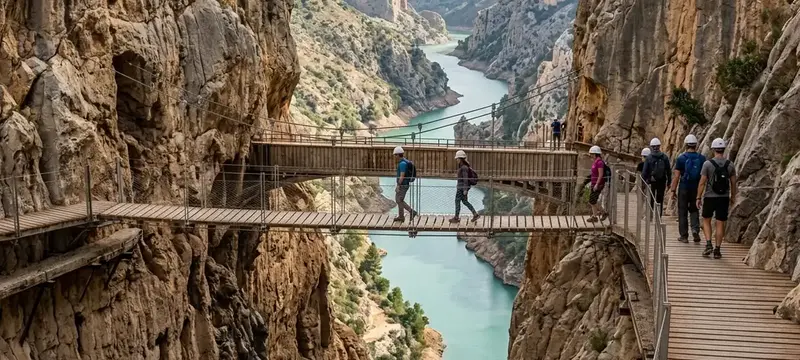
It stays open and it is still worth the day, but the gorge channels direct sun and the exposed stretches get considerably hotter than the coast. Book the first entry slot of the day, which is 08:30 on the summer timetable, carry more water than feels sensible, and treat an afternoon slot in August as a bad idea rather than a brave one.
The ticket system is the harder part and it has nothing to do with the heat: the year's supply is released in a few large batches and there are no sales at the gate. The Caminito del Rey ticket guide covers what still works once your date shows sold out.
Is summer the right season for you?
If the sea is the point, yes, and nothing else in the Málaga year competes – the water is at its warmest, the evenings run to midnight and the festival calendar is full.
If walking the old town and the monuments is the point, the numbers argue against it. September holds a 28.2°C average maximum with the sea still at its summer peak, and it does it without August prices or August crowds. That is the single easiest improvement available to a summer trip here: move it two weeks later.
FAQ – Málaga in summer
Images: Alexey Komarov / Wikimedia Commons / CC BY-SA 4.0
Reader Comments 💬
Share your experience or ask a question