
Málaga's winter averages a 17.3°C afternoon and a 7 to 9°C night across December, January and February – walking weather in direct sun, a real coat after dark. Almost every guide prints that as one flat band, which hides what you actually need. The three months differ enough to decide which one you book: December has the lights and the most rain, January the emptiest monuments, February the best weather of the three.
The three winter months, separated out
These are AEMET's normals for the Málaga Airport station (6155A), reference period 1981–2010, taken from the Málaga weather by month guide.
| Measure | December | January | February |
|---|---|---|---|
| Average daily maximum | 17.5°C | 16.8°C | 17.7°C |
| Average daily minimum | 8.9°C | 7.4°C | 8.2°C |
| Monthly rainfall | 100 mm | 69 mm | 60 mm |
| Days with measurable rain | 6.6 | 5.8 | 4.8 |
| Monthly sunshine | 160 hours | 180 hours | 180 hours |
Two things in that table upend the usual summary. January is the coldest month on both rows – 16.8°C by day and 7.4°C at night – but it is not the wettest. December is, at 100mm over 6.6 days, and it is the joint wettest month of the entire Málaga year alongside November.
And the rain falls away steadily from there: February takes 60mm over 4.8 days, which is 40% less than December and the driest winter month by a clear margin. The commonly printed "8–10°C nights" floor is also too high for January, which averages 7.4°C.
The January guide has the full month in detail, including the Three Kings parade and what a 9.4-degree daily swing feels like on the ground.
What 17°C in the afternoon and 8°C at night actually means
The single figure that shapes a winter day here is not the maximum. It is the eight-to-nine-degree gap between the afternoon and the evening, which is wide enough that one set of clothes will not cover both.
At 14:00 in direct sun on a sheltered street, 17°C is genuinely pleasant, and you will see people eating outside without hesitating. The same day at 19:00, with the sun behind the buildings and damp air coming off the water, is an 8°C evening. Relative humidity runs around 70% through the winter, so that evening reads colder on the skin than 8°C does anywhere dry.
Layering is the whole answer: a light or mid-weight jacket by day, something warmer for the seafront after dark, and a packable waterproof. Rain here arrives the way it does across the Andalusian winter – short heavy bursts with clear sky either side, not all-day grey. Across five or six rain days in a month, carrying a waterproof daily beats checking the forecast. Snow in the city is effectively unheard of.
What winter actually costs
Accommodation and flights are at their annual floor from mid-November through February, with one exception: the Christmas and New Year window, when prices lift again for about a fortnight before dropping back.
No verifiable percentage exists for how much cheaper it is. This page previously said "10 to 40%", and that range has no source behind it.
The honest version is that the direction is reliable and the size is not, because it depends on the property, the week and how far ahead you book. January and February are the cheapest weeks of the year here by a comfortable margin, but treat any specific figure as marketing rather than data.
What is genuinely free is the thing winter is actually for. The Calle Larios Christmas lights run from late November to 5 January and cost nothing, the Three Kings parade on 5 January costs nothing, and the Carnaval street events in February cost nothing.
The city with nobody in it
This is the real argument for a winter trip and it is not a weather argument.
The Alcazaba and Gibralfaro are open every day of the year, and in January you walk in. No queue, no cruise-group crush at mid-morning, and the terraces at midday are quiet, warm and effectively yours – the one season you can climb those walls at noon without wilting. The old town is the same story: Calle Larios and Plaza de la Constitución are walkable rather than something you get swept along by.
The museums are the winter default for the six rain days. The Picasso Museum, Carmen Thyssen and Centre Pompidou all see a fraction of their summer queues, and the first two sit close enough together for an easy combined day.
The seafront still works. The promenade east toward Pedregalejo and El Palo is one of the better winter walks in the city, and the chiringuitos that stay open through winter are cooking rather than renting sunbeds. What does not work is the water: the sea sits around 14–16°C from December to February, there are no lifeguards on the city beaches, and that is a swim for people who swim in mid-teens water at home.
Check opening hours around the holidays before you plan a day
The winter calendar
Three fixed points, and none of them needs a ticket.
- Christmas lights, late November to 5 January. Calle Larios gets a bespoke overhead canopy and a choreographed light-and-music show every evening. It is free, it is the busiest street in the city on a December Saturday, and a weekday visit is a completely different experience of the same lights.
- Cabalgata de Reyes Magos, the evening of 5 January. Floats through the centre with sweets thrown into the crowd, and locally a bigger night than Christmas Day. The date never moves; the start time is confirmed only a few weeks ahead and can slip on the day.
- Carnaval, 7 to 15 February 2026. Comparsa groups performing musical satire at the Teatro Cervantes, free street parades around Plaza de la Constitución, and a finale on 15 February – the Burial of the Anchovy, a mock funeral for a symbolic fish on Malagueta beach.
Belenes, the elaborate nativity scenes, go up across the city through December in churches and public buildings and are free to walk in and look at.
Day trips in winter
Cool air and empty paths make this the better half of the year for the inland trips, with one hours caveat that catches people out.
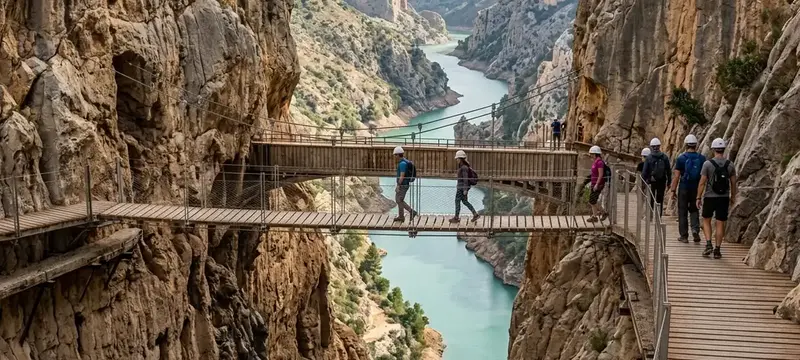
Caminito del Rey switches to a winter timetable. The path opens Tuesday to Sunday and closes Mondays, plus 24, 25 and 31 December and 1 January, and entry slots run roughly 09:00 to 16:00 in winter against 08:30 to 17:00 in summer and autumn.
Cooler air makes the 7.7km of boardwalks far more comfortable than the summer version, and low winter light in the gorge is the best of the year. Book online: official tickets are non-refundable, there is no gate sale, and heavy rain or strong wind can close the path at short notice.
Ronda is the other one worth the day. The Tajo gorge in low winter light with nobody on the Puente Nuevo is a different city from the one the coaches see at 11:00 in August. It is about 1 hour 30 by car from Málaga, or roughly 2 hours 15 by direct bus – not the "hour or so" often quoted, so start early.
The day trips guide covers the rest. Winter timetables on some coastal routes thin out, so check the day before rather than the week before.
Is winter right for you?
Come in winter if the point of the trip is the city rather than the coast. You will walk into every monument, get a table anywhere without booking, pay the lowest room rates of the year, and see Málaga behaving like a working Spanish city instead of a holiday destination. December adds the lights on top; January and February strip it back furthest and cost least.
Do not come in winter if swimming is the point. The sea is 14–16°C, a good number of beach businesses are shut, and no amount of 17°C afternoons compensates. May, June or September give warm water without August prices, and every month is set against the others on the weather hub linked at the top of this page.
Images: Maximo88 / Wikimedia Commons / CC BY-SA 4.0
Reader Comments 💬
Share your experience or ask a question