
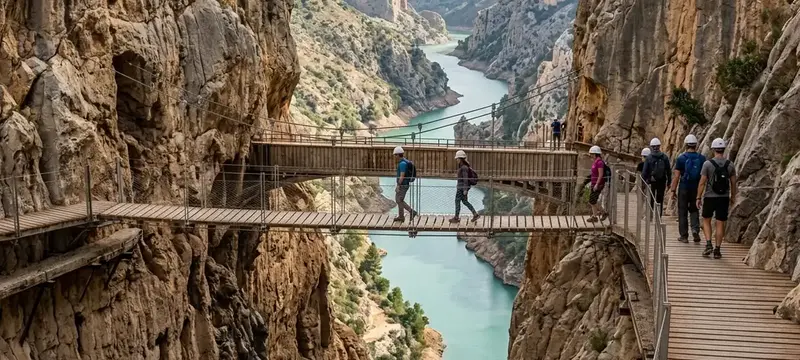
Málaga is one of the easier Spanish cities to arrive in cold: the airport sits 8 km out, the old town is walkable end to end, and English gets you further than it should. What catches people is not difficulty, it is bad information – buses described as cash-only when they take contactless, a tram that has not existed for decades, and dinner reservations made for 19:00.
Every figure below was checked against the operators' own tariffs, and the ones this page used to get wrong are named.
Getting in from the airport, at the real prices
Three ways across those 8 km, and the gap between them is wider than the distance suggests.
| Route | Cost | Best for |
|---|---|---|
| Cercanías C1 train | €1.80 | one or two people with manageable bags |
| EMT Express bus, line A | €4.00 flat | hotels nearer Paseo del Parque than the station |
| Taxi from the rank | from €18.24 daytime | three or four people, or a late landing |
The train reaches Málaga Centro-Alameda, the stop for the old town, and you can tap a contactless bank card straight at the turnstiles instead of buying a ticket.
The €18.24 taxi figure is not an estimate: the council sets a separate legal minimum for journeys starting at the airport, and it rises to €25.80 at night. Split four ways that comes to about €4.35 each, which is why the comparison closes at group size rather than at distance.
The airport transfer guide sets the options against each other, including the late-arrival gap when the C1 is not running.
A city bus is €1.40, and it is not cash only
This is the most repeated error about Málaga. A single EMT ride costs €1.40 and you can pay for it with cash, a contactless bank card, or a QR ticket bought in the EMT app – identical fare, so the choice is convenience rather than money.
The one hard rule is the note limit: cash payment does not accept notes above €5, which is why a €20 at the bus door is still the classic way to miss a bus. Carry coins and the question never arises.
If you expect to use the bus more than once, the CTMAM travel card costs €1.50 to issue and drops the same ride to €0.50, so it has paid for itself on your second journey. That is a much lower bar than the multi-day rule most guides give it. The public transport guide has the metro, Cercanías and interurban fares on the same card.
Málaga has no tram
On foot, and when not to be
The centre is genuinely compact: the cathedral, the Roman theatre, the Alcazaba, the Picasso Museum, the Atarazanas market and Muelle Uno all sit inside a fifteen-minute walk of one another. Shoes with grip matter more than distance, because the lanes around Calle Alcazabilla are uneven and polished smooth in places.
Two exceptions to walking. The climb to Gibralfaro is twenty minutes uphill and a bad idea between 13:00 and 17:00 in July and August – bus 35 does it for €1.40. And the eastern beach neighbourhoods are 20 minutes out on bus 11 rather than a stroll.
For anything else, Uber, Bolt, Cabify and FreeNow all operate in Málaga, which gives you a price before you get in. Ordinary metered taxis start from a €4.65 minimum fare on a short city run, so the difference on a two-kilometre hop is usually small.
Eat on Spanish time or eat alone
Lunch runs roughly 14:00 to 16:00 and is the main meal of the day. Dinner starts around 21:00. Arriving at a restaurant at 19:00 in summer gets you an empty room and a kitchen still doing its prep, and it is the single most common visitor mistake here.
The item worth ordering is the menú del día: two courses, bread, a drink and dessert, served on weekday lunchtimes, and typically €10 to €15. It is how the city eats well without thinking about it, and it is the biggest single gap between what locals pay and what visitors pay. Where to find the good ones, and which dishes are actually from here, is in the Málaga food guide.
Money, tipping and a few words of Spanish
Cards work almost everywhere, including on buses, but small bars, market stalls and some ticket machines still prefer cash. Carry a few €1 and €2 coins and the problem disappears.
Tipping is relaxed and never obligatory. Round up at a café or a bar, leave €1–2 a head at a tapas bar, and 5–10% is generous for good service at a sit-down meal. Taxis get rounded to the nearest euro.
A few words go further than the effort deserves. "Buenos días" on entering a bar, "la cuenta, por favor" for the bill, and "¿hay tapa?" to find out whether a drink comes with something – that last one is how you discover which bars still do it.
The days and hours that shut things
This is the part that costs people a morning, and none of it is advertised in English.
- Weekly closures: the Centre Pompidou closes every Tuesday, and the Carmen Thyssen every Monday. The Picasso Museum opens every day of the week, including Monday, which is unusual in Spain.
- The midday gap: the Automobile and Fashion Museum shuts from 14:30 to 16:00. Arrive before 13:00 or after 16:00.
- Markets are mornings: Atarazanas trades Monday to Saturday and starts packing up between 13:00 and 14:00. There is no afternoon market.
- Public holidays: 1 and 6 January, 15 August and 25 December close most things, with reduced hours on 24 and 31 December.
- The two full weeks: Semana Santa – 21 to 28 March in 2027 – and the Feria in mid-August fill the city completely and need accommodation booked three to six months ahead.
When to come, by the actual record
AEMET's normals make the case for the shoulder seasons plainly. May averages a 24.3°C daily maximum with 292 hours of sun, and October 24.1°C – two-tenths of a degree apart on land, but with a sea around 18–20°C in May against 21–23°C in October.
July and August average 30.5°C and 30.8°C, which is two to three degrees below the figures most summer pages print, and both months hold overnight minimums above 20°C. Winter is mild rather than warm and has the year's lowest prices. The weather guide has every month as the official record has it.
If your plans include Ronda, El Torcal or the villages inland, none of the above reaches them and the car hire guide covers the terms worth reading before you book.
FAQ – practical questions about Málaga
Images: JamesNarmer / Wikimedia Commons / CC BY-SA 4.0
Reader Comments 💬
Share your experience or ask a question