
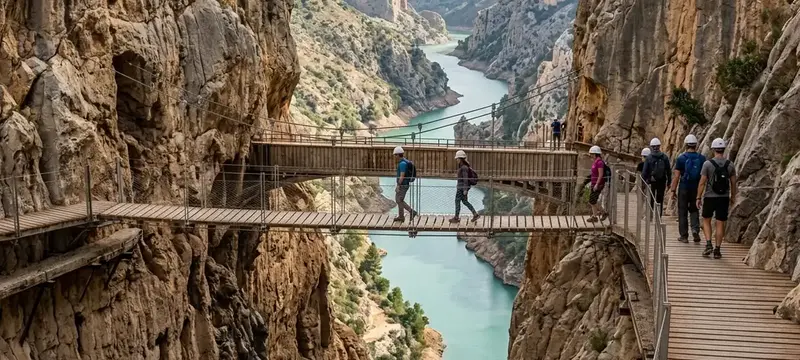
Marbella runs two cities in parallel: the superyachts and beach-club prices of Puerto Banús, and a whitewashed 15th-century old town where croquetas cost ~€3 and locals outnumber tourists before 10:00. The best trips mix them – a beach-club day, an Old Town tapas night. Only three things need booking before you fly: Skina, an Ocean Club bed on a summer Saturday, and Caminito del Rey. The rest can be decided the morning you wake up.
Your First Day, Hour by Hour
- 109:00
Old Town – Plaza de los Naranjos
Start before the crowds. Orange trees, Moorish walls, coffee at a terrace café. The whole Old Town covers in 90 minutes on foot.
- 211:00
Paseo Marítimo walk
7km flat promenade toward Puerto Banús. Walk as far as you like – the Dalí sculptures on Avenida del Mar are on the way.
- 313:00
Lunch at Bar El Estrecho
Back in the Old Town backstreets. Croquetas and ensaladilla rusa from ~€2–3 per tapa. Locals only. Go before 14:00.
- 416:00
Catamaran dolphin watching
2-hour catamaran with a swimming stop, from €35. Common and bottlenose dolphins are here year-round. Morning slots sight better.
- 519:30
Sunset drinks
Belvue at Amàre for the best 360° sunset in Marbella, or walk Puerto Banús marina as the sun drops.
- 621:00
Dinner – Golden Mile or Old Town
Lobito de Mar for a proper sit-down (€60–100 a head), or El Estrecho if you kept the budget for something else.
The Old Town (Casco Antiguo)
Do this on your first morning, before anything else. The Old Town is why Marbella is still worth visiting now that most of the coast has been paved over – a genuine medieval quarter of Moorish walls, whitewashed lanes and orange trees that works as a real neighbourhood, not a tourist set, and the part of the town most visitors regret not giving more time.
Plaza de los Naranjos, the 15th-century main square, is the heart of it, best before 10:00 or after 20:00. The lanes cover the quarter in about 90 minutes on foot, and the 9th-century Murallas del Castillo run through it. It is also where Marbella eats best – €2–3 croquetas at Bar El Estrecho, two Michelin stars at Skina. The Marbella Old Town guide covers the quarter as a base, not just a morning.
The dining is laid out properly in the Marbella restaurants guide, and the Old Town boutique hotels guide covers staying inside the walls.
Beach Clubs, Supercars & Puerto Banús
This is the Marbella the global reputation is built on. Ocean Club in Puerto Banús wrote the beach-club playbook and still runs it best – one of Europe's largest saltwater pools, a DJ from 15:00, minimum-spend beds quoted on request rather than published, and a peak Saturday that is a wasted trip without a reservation.
East in Elviria, Nikki Beach runs quieter and more family-friendly, better for a long lunch than a party. The full comparison is in the beach clubs guide.
The marina itself is free to walk and unlike anywhere else in Europe: charter yachts on one side, Lamborghinis and Rolls-Royces parked outside the boutiques on a normal Tuesday. The Puerto Banús guide covers the marina as a place to spend an evening or a week, including the parking and the Saturday market.
To get on the water, see the yacht charter guide; to get behind the wheel, the supercar hire guide covers the reputable operators and what to check before you sign.
On the Water: the Catamaran Dolphin Trip
Common and bottlenose dolphins are resident in this stretch of the Alborán Sea year-round, and a good operator finds them on almost every trip; striped dolphins stay further offshore and are a rarer sight. The catamaran format, with no engine noise and dolphins under the bow, beats a motorboat tour and is far better with children. At the price it is the best-value paid activity on this coast.
The basic catamaran runs about two hours from €35 with a swimming stop; the small-group sailing and dolphin trip runs two to two and a half hours from €60 with drinks. Morning departures outperform afternoons for both sightings and sea conditions, and are calmer if anyone is prone to seasickness. Every operator and price band is in the Marbella boat trips guide.
Free Marbella
A surprising amount of the best of Marbella costs nothing. Avenida del Mar, the avenue linking Parque de la Alameda to the seafront, holds ten original Salvador Dalí bronzes installed in the 1990s – surrealist art on a Spanish promenade that most visitors walk straight past.
Museo Ralli on the Golden Mile is a genuinely good contemporary art museum (Dalí, Chagall, Latin American masters) and entry is free. It opens Tuesday to Friday 10:00–17:00 and Saturday mornings, closes Sunday and Monday, and shuts for about a month around Christmas and January – so it is a warm-season option, not a winter one.
The Paseo Marítimo runs seven flat kilometres of seafront promenade from the centre to Puerto Banús, with beach clubs opening straight onto it and, on clear days, views across to the Rif Mountains of Morocco. By bike it is the easiest way for families to cover the waterfront without a schedule.
Into the Mountains: La Concha, Golf & Buggies
The shark-fin peak visible from everywhere in Marbella is La Concha (1,215m), and the summit views – the full coast, Gibraltar, the Rif across the strait – are the best in Marbella and cost nothing. Start before 09:00 in summer; the exposed ridge gets dangerous after 10:00 in heat. It is not for under-10s, and guided versions run from around €80 if you would rather not go alone.
Inland, the Golf Valley in Nueva Andalucía has more courses per kilometre than almost anywhere in Europe – Los Naranjos, Las Brisas, Aloha and La Quinta, all within 15 minutes of the marina. Only Los Naranjos and La Quinta sell a visitor green fee, roughly €130–180; the other two are members' clubs.
For a different kind of day, guided off-road buggy tours run into the Sierra Blanca behind the town with mountain and sea views – the best pick for mixed groups who have done the beach.
Day Trips Worth Leaving the Coast For
Marbella has no train station, so every trip inland means a car, an Avanza coach or a guided tour. Ronda is the one to do first, Caminito del Rey the best active day out, and Málaga city the one that trades beach for the Picasso Museum and a cheaper tapas scene. Drive times, bus options, ticket prices and the closures worth knowing about are all in the day trips guide.
Marbella in Winter & When It Rains
December to March is the least-visited window and, depending on what you want, the best time to come: the Old Town is quiet, summer-impossible restaurants have tables, and it averages 15–18°C with 6–7 hours of sun – cold for swimming, excellent for walking and the La Concha hike.
When it rains, La Cañada shopping centre in Ojén (150 shops, 15 minutes by taxi) and a long lunch at Skina or Lobito de Mar both beat a beach day. Do not build a wet December afternoon around Museo Ralli – it closes for about a month around Christmas and January, which is exactly when you would want it. The month-by-month detail is in the Marbella weather guide.
How to Do Marbella Right
Spend the first morning in the Old Town before anything else – at 09:00 on a weekday it is the best version of Marbella. Add one catamaran morning, one beach-club day if that is your scene, a sunset from Belvue or the Paseo Marítimo, and either La Concha or a day inland if you want to remember Andalusia exists beyond the seafront.
The mistakes are all timing rather than taste. The Old Town at midday in July and August is the worst hour to see it, Ocean Club on a peak Saturday does not work without a reservation, and the La Concha ridge after 10:00 in summer heat is genuinely dangerous rather than merely uncomfortable.
If the open question is still whether the town justifies the trip at all, is Marbella worth visiting takes the reputation and the price argument head-on.
Planning Your Visit
Three full days is the sweet spot: one for the Old Town and Paseo Marítimo, one for a beach club or catamaran day, one for Puerto Banús or a day trip. Most of Marbella can be improvised, but a few things sell out – top restaurant tables, beach-club beds on summer Saturdays, and Caminito del Rey slots. Lock those before you arrive and leave the rest loose.
Which end of town you sleep in changes the shape of all three days, and where to stay in Marbella takes it neighbourhood by neighbourhood. Day-by-day plans for one, two, three and seven days, with what each costs, are in the Marbella itinerary guide.
FAQ – Things to Do in Marbella
Images: Harvey Barrison from Massapequa, NY, USA / Wikimedia Commons / CC BY-SA 2.0
Reader Comments 💬
Share your experience or ask a question