Seville Day Trip 2026: From Malaga, Marbella & the Costa del Sol
A day trip to Seville from the Costa del Sol is one of the best decisions you can make on a holiday in Andalusia — and one of the most consistently underused. The city is two hours from Malaga by high-speed train. The ticket costs less than a restaurant meal. And what you find at the other end is the largest Gothic cathedral on Earth, a royal palace that has been in continuous use for over 700 years, and a neighbourhood of orange-tree courtyards and tapas bars that would take a week to exhaust properly.
This guide covers how to get there from five Costa del Sol towns, what is worth your limited time and what to skip — with a practical itinerary for 4, 6 and 8 hours in the city. Because the single biggest mistake people make in Seville is trying to see everything. The second biggest is not going at all.
Jump to: From Malaga · From Torremolinos · From Benalmadena · From Fuengirola · From Marbella · Seville Cathedral · Real Alcazar · Barrio de Santa Cruz · Plaza de Espana · Triana · Practical Tips · FAQ
| From | Best Route | Journey Time | Return | Difficulty |
|---|---|---|---|---|
| Malaga | AVE from María Zambrano | ~2h | Easy | ⭐ |
| Fuengirola | Cercanías + AVE | ~2h 15min | Easy | ⭐ |
| Torremolinos | Cercanías + AVE | ~2h 20min | Easy | ⭐ |
| Benalmadena | Cercanías + AVE | ~2h 25min | Easy | ⭐ |
| Marbella | Bus or car | ~2h 30min | Moderate | ⭐⭐ |
Getting to Seville
From Malaga
🚄 2 hours by high-speed train — the best connection on the coast
Malaga is the easiest and most direct starting point for a Seville day trip. The AVE and Avlo high-speed trains run from Málaga María Zambrano station directly to Sevilla-Santa Justa, journey approximately 1h 55min–2h 05min. This is fast, comfortable and the clear first choice.
By train: Book through Renfe.com. AVE fares vary significantly by booking window — from around €15–20 one way booked weeks in advance on Avlo (the budget high-speed service) to €50–90 on flexible AVE tickets. Book as early as possible for the best prices. Multiple departures daily, first trains around 6:30–7:00am.
By bus: Alsa and FlixBus operate Malaga–Seville services, approximately 2h 30min–3h, from around €10–20. Cheaper than the train but significantly slower. Worth considering for a very early or very late return when train options are limited.
By car: Around 2h 10min via the A-92 motorway. Useful if you are combining Seville with other stops, but parking in the city centre is expensive and unnecessary given how good the train is.
If you are basing yourself in Malaga city for part of your trip, our things to do in Malaga guide covers the city in full — worth combining with a day in Seville for a genuine Andalusian double.
🎫 Book a Seville day trip from Malaga — guided tours include Alcazar access and a local guide, solving the ticket booking problem in one step.
From Torremolinos
🚂 2h 20min via Cercanías and AVE — straightforward two-leg journey
From Torremolinos, take the Cercanías C-1 line east to Málaga María Zambrano (approximately 20–25 minutes, around €2.50), then connect to the AVE or Avlo to Seville. The connection at María Zambrano is easy — the Cercanías and long-distance platforms are in the same station building.
By train: Allow 20–30 minutes connection time at María Zambrano to be comfortable. Total journey Torremolinos to Sevilla-Santa Justa: approximately 2h 20–30min. Book the Malaga–Seville leg in advance on Renfe.com.
By guided tour: A guided day trip from the Costa del Sol avoids all the ticket coordination and typically includes Alcazar entry — the single hardest logistical element of a Seville day. For other day trips reachable from Torremolinos, see our Torremolinos day trips guide.
🎫 Book a Seville guided day trip from Torremolinos — transport, Alcazar entry and local guide included.
From Benalmadena
🌊 2h 25min via Cercanías and AVE — same easy two-leg route
From Benalmadena-Arroyo de la Miel, take the Cercanías C-1 east to Málaga María Zambrano (approximately 25–30 minutes), then connect to the high-speed service to Seville. The logistics are identical to Torremolinos — straightforward and well signposted.
By train: Total journey approximately 2h 25–35min. Book the Malaga–Seville segment on Renfe.com well in advance for the best fares. Avlo tickets from Malaga to Seville can be as low as €10–15 booked a month ahead.
By guided tour: The most popular option for Benalmadena visitors who want a hassle-free day. Coaches pick up from Arroyo de la Miel or Benalmadena Costa and handle all logistics. See our Benalmadena day trips guide for the complete picture of what is reachable from the town.
🎫 Book a Seville day trip from Benalmadena — guided full day with Alcazar access included.
From Fuengirola
🏖️ 2h 15min — the fastest train connection outside Malaga
Fuengirola is the westernmost Cercanías station on the C-1 line before Malaga, which makes the overall journey to Seville slightly shorter than from Torremolinos or Benalmadena. Take the Cercanías east to Málaga María Zambrano (approximately 40–45 minutes from Fuengirola), then the AVE or Avlo to Seville.
By train: Total journey approximately 2h 15–25min. The Fuengirola–Malaga Cercanías leg is longer than from Torremolinos, but the same Malaga–Seville high-speed segment applies. Book in advance on Renfe.com.
By guided tour: Most Costa del Sol Seville tour operators include Fuengirola as a pickup stop.
🎫 Book a Seville day trip from Fuengirola — full day with transport and guided Alcazar visit.
From Marbella
🌴 2h 30min by bus or car — no direct train but entirely doable
Marbella has no train station, which makes Seville slightly more logistical than from the Cercanías towns. The two practical options are bus to Malaga and onward by train, or driving directly.
By bus + train: Take a bus from Marbella to Malaga (approximately 45min–1h on the regular or express service), then the AVE from María Zambrano to Seville. Total journey approximately 2h 45min–3h. Less elegant than a direct train but perfectly workable for an early departure.
By car: Around 2h 10–20min via the A-92 motorway from Marbella. Driving gives flexibility on timing but requires parking in Seville — use the car parks near the Alameda de Hércules or on the Isla de la Cartuja and take the tram or walk into the centre.
By guided tour: The most practical option from Marbella. Several operators run dedicated Costa del Sol–Seville day trips with Marbella pickup included.
🎫 Book a Seville day trip from Marbella — guided day with coach from Marbella and Alcazar included.
Seville Cathedral
⛪ The largest Gothic building on Earth — and Magellan is buried inside
Seville Cathedral was built between 1401 and 1528 on the site of a former Moorish mosque, and it was built with explicit ambition — the chapter records from 1402 include the instruction to construct a building "so beautiful and so grand that those who see it finished will think we were mad to attempt it." They were not mad. The result is the largest Gothic cathedral in the world by volume, the third largest church on Earth by any measure, and one of the most extraordinary interiors in Europe.
The Giralda — the bell tower — is the former minaret of the mosque, converted and extended after the Reconquista. Climbing it is not stairs but a series of ramps, wide enough that horses once carried dignitaries to the top. The view over Seville from the top is the best in the city.
Christopher Columbus is buried here, in an elaborate tomb carried by four allegorical figures representing the kingdoms of Castile, León, Navarre and Aragon. Ferdinand Magellan, who began but did not complete the first circumnavigation of the globe, also has a monument inside.
Practical information:
- Entry: approximately €12–14 per adult including the Giralda (2026 — check official site for current prices)
- Opening hours: Monday 11am–3:30pm, Tuesday–Saturday 11am–5pm, Sunday 2:30pm–6pm (verify before visiting — hours change seasonally)
- Time needed: 1.5–2 hours minimum. The interior is vast
- Book in advance: Online booking is strongly recommended in spring and summer — queues for walk-up tickets can exceed 90 minutes
Pro tip: The cathedral is free to enter on Monday afternoons from 4:30–6pm for worshippers — this is not advertised prominently but is genuine policy as of 2026. Arrive at 4:15pm, queue briefly at the main entrance, and the interior is yours for 90 minutes at no charge. The light through the stained glass in late afternoon is extraordinary.
Anyone visiting Seville for the first time. The cathedral is not optional — it is the reason the city exists in its current form and the most complete expression of medieval Christian ambition in stone anywhere in Europe. The Giralda climb alone is worth the entry price.
Travellers with very limited mobility — the cathedral interior involves significant walking on uneven stone floors. The Giralda ramps are manageable for most people but the overall visit requires stamina. Also avoid if you are pressed for time and already have the Alcazar booked — the two together need 4 hours minimum.
Real Alcazar
🏰 A royal palace still in use after 700 years — book before anything else
The Real Alcázar is a UNESCO World Heritage Site and the oldest royal palace in Europe still in active use — the Spanish royal family uses it as their official Seville residence when in the city. It was begun by Moorish rulers in the 10th century, expanded by Christian kings after the Reconquista, and has been continuously modified, decorated and occupied ever since.
The result is one of the most layered and extraordinary buildings in the world: Moorish arches and tilework alongside Gothic vaulting alongside Renaissance ceilings alongside 20th-century additions, all coexisting in a palace that feels simultaneously ancient and alive. The Patio de las Doncellas — the Court of the Maidens — is the most reproduced image from the Alcázar and the most beautiful room in Seville. The gardens extend for hectares behind the palace with fountains, orange trees and a genuine sense of having stumbled into a place that the rest of the city does not know about.
The Alcázar was used as the filming location for the Water Gardens of Dorne in Game of Thrones. This is now mentioned on every tour. It is still worth going.
Practical information:
- Entry: approximately €14.50 per adult for the general visit (2026 — check the official Alcázar website for current rates)
- Opening hours: October–March 9:30am–5pm, April–September 9:30am–7pm
- Time needed: 2–2.5 hours minimum for palace and gardens
- Book well in advance. The Alcázar operates timed entry with a daily visitor limit. In spring and summer, tickets can sell out 2–3 weeks ahead. This is the single most important booking to make before your Seville trip — treat it exactly like Alhambra tickets for Granada
Pro tip: Book the first available entry slot of the day — typically 9:30am. The palace is dramatically less crowded in the first 90 minutes than at any other point. By 11am the tour groups arrive and the Patio de las Doncellas becomes difficult to photograph. The early slot also means you finish the Alcázar before the cathedral gets busy, giving you two major sights done by lunchtime.
Every visitor to Seville — the Alcázar is not optional. It is arguably the most beautiful interior in Spain and the gardens alone justify the entry price. If you can only book one thing for a Seville day trip, book this.
Last-minute planners in spring or summer who have not booked in advance. Arriving without tickets means no entry — there is no walk-up availability on busy days. Book the moment your Seville date is confirmed. A guided day trip that includes Alcázar access solves this automatically.
🎫 Book a Seville Alcazar guided tour — includes guaranteed entry with a guide inside the palace. The most reliable way to secure access.
Barrio de Santa Cruz
🍊 The old Jewish quarter — the most beautiful neighbourhood in Seville
The Barrio de Santa Cruz is the former Jewish quarter of Seville, a compact labyrinth of whitewashed lanes, orange-tree courtyards, wrought-iron balconies and hidden plazas immediately east of the cathedral and Alcázar. It is the neighbourhood that appears in every photograph of Seville and the area where most visitors spend the most unplanned time — arriving intending to walk through and leaving two hours later.
The lanes are genuinely too narrow for cars. Flowers cascade from balconies. Small restaurants have tables in courtyards that are accessible only through an archway that looks like a private entrance. The Plaza de los Venerables and the Plaza de Santa Cruz are the two main squares — both beautiful, both with good restaurants on the perimeter.
The Barrio is also the best place in Seville for tapas. Not the tourist-facing places on the main pedestrian streets — the better ones are one or two streets removed, identifiable by the Spanish clientele and the handwritten menus. Jamón ibérico, salmorejo (the thick Andalusian cousin of gazpacho), pescaíto frito and montaditos are the things to order.
Time needed: 1–2 hours to walk properly. Longer if you stop for lunch or tapas, which you should.
Pro tip: The best time in the Barrio de Santa Cruz is early evening — after 7pm when the day-trip coaches have left and before the evening dinner rush at 9pm. The light is golden, the lanes are quieter and the tapas bars are at their most alive. If your train back allows it, plan for a 7–8pm hour in Santa Cruz before the last return.
Everyone — the Barrio de Santa Cruz is free, beautiful and the best 90 minutes you can spend in Seville outside the ticketed monuments. Couples, solo travellers and families all find something here. Get genuinely lost in it.
No one should avoid it — but visitors expecting a quiet, undiscovered neighbourhood will find it busy in peak season. The lanes are narrow and popular; the charm persists regardless.
Plaza de Espana
🌊 The most photogenic square in Spain — and it is free
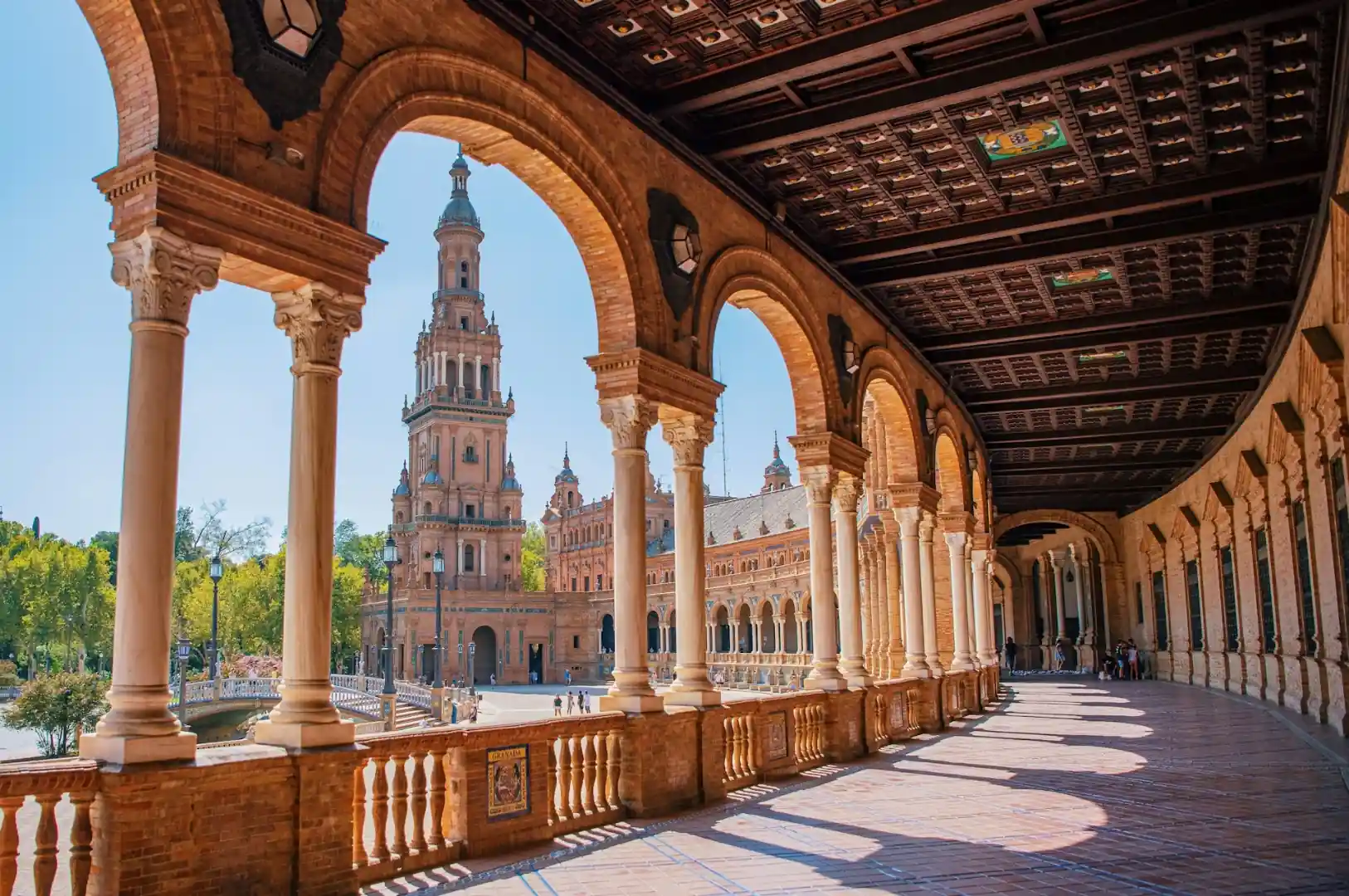
The Plaza de España was built in 1928 for the Ibero-American Exposition and has remained one of the most extraordinary public spaces in Europe ever since. It is a vast semicircular building of brick and tile surrounding a canal and fountain complex, with 48 tiled alcoves around the perimeter representing each province of Spain. Gondola-style boats for hire drift along the canal below ornate bridges. The scale is theatrical and the detail is extraordinary — every alcove has hand-painted tilework depicting a historical scene from its respective province.
It is also, technically, recognisable from Star Wars: Attack of the Clones, where it served as the capital city of Naboo. This does not diminish the experience. It might enhance it, depending on your perspective.
The Plaza de España is a 15–20 minute walk from the cathedral, or a short tram ride. Entry is free. It is never not busy but it is large enough that the crowds dissipate within the space.
Time needed: 45–60 minutes to walk the perimeter and find your province's alcove.
Pro tip: The best photography at Plaza de España is either very early morning (before 9am, when tourist numbers are low and the light is soft) or in the evening after 6pm when the tile colours are richest and the canal reflects the building. Midday in summer is the worst time — harsh light, full crowds, and genuinely hot stone underfoot.
Anyone who cares about architecture, photography or simply being in an extraordinary public space for no cost. Plaza de España is one of those places that genuinely surprises people — the photographs do not fully prepare you for the scale.
Day-trippers with only 4–5 hours in Seville who have the Cathedral and Alcázar on their list. Plaza de España is 20 minutes from the main monuments and requires at least 45 minutes to see properly — on a very tight day, it may not fit without rushing the big two.
Triana
🎸 Flamenco, ceramics and the Seville that tourists mostly miss
Triana is the neighbourhood across the Guadalquivir river from the city centre — connected by the Puente de Isabel II (the Triana Bridge) and separated from the tourist circuit by exactly enough distance that most day-trippers never make it over. This is your advantage.
Triana is the historic home of Seville's flamenco tradition and its ceramics industry. The Calle Alfarería (Pottery Street) still has working ceramic workshops producing the hand-painted tiles that line buildings across Andalusia. The neighbourhood has a covered market, the Mercado de Triana, with excellent fresh produce and a tapas bar area that operates at genuinely local prices. The riverside promenade on the Triana side looks back at the Seville skyline with the Torre del Oro and the cathedral tower visible simultaneously.
Getting there: 10–15 minute walk from the city centre across the Triana Bridge. No transport required.
Time needed: 1–1.5 hours for a proper visit, including the market and a stop at a ceramics workshop.
Pro tip: The Mercado de Triana is at its best in the morning from 9am–1pm when the food stalls are operating and the bar inside is serving breakfast. The ceramics workshops on Calle Alfarería are open most mornings and welcome visitors — you can watch tiles being hand-painted and buy directly at workshop prices, which are significantly lower than the tourist shops near the cathedral.
Independent travellers and anyone wanting to see the Seville that locals actually live in rather than the one designed for tourists. Triana is genuine, affordable and 15 minutes from the cathedral. It makes the difference between a tourist visit and a real day in the city.
Day-trippers with under 5 hours in Seville. Triana adds significant value to the day but requires time — if you are working through the Cathedral, Alcázar and Santa Cruz on a tight schedule, Triana may not fit. Prioritise it on longer visits.
Practical Tips
The Alcázar is the first thing to book. Before you book the train, before you book accommodation, before you book anything else about your Seville day — go to the official Alcázar website (alcazarsevilla.org) and check availability for your date. In spring and summer, tickets sell out 2–3 weeks ahead. If they are gone, consider changing your date rather than going without.
Book the earliest train possible. The Malaga–Seville AVE takes 2 hours. If you leave Malaga at 7am you arrive at 9am and have 8–10 hours in the city before the last comfortable return. Leave at 9am and you have 6 hours, which is rushed for Cathedral + Alcázar + anything else. Early departures are the difference between a great day and a stressful one.
Do not try to see everything. Seville has the cathedral, the Alcázar, Santa Cruz, Plaza de España, Triana, the Torre del Oro, the Museum of Fine Arts, the Flamenco Museum and a dozen other significant attractions. In a single day, do three or four things properly rather than eight things rushed. The itinerary below is a reliable framework:
- 4 hours: Alcázar + Barrio de Santa Cruz
- 6 hours: Alcázar + Cathedral + Barrio de Santa Cruz
- 8 hours: Alcázar + Cathedral + Plaza de España + Triana
Avoid July and August if possible. Seville regularly reaches 42–44°C in peak summer and is one of the hottest cities in Europe. Spring (March–May) and autumn (September–October) are dramatically more comfortable for a full day of walking. If summer is your only option, start early, rest between 1–4pm, and revive for the evening.
Explore the full range of Andalusian day trips on our day trips hub — Seville is the biggest commitment in terms of distance but one of the most rewarding days available from the Costa del Sol.
FAQ
How long does it take to get from Malaga to Seville by train? Approximately 1h 55min–2h 05min on the AVE or Avlo high-speed service from Málaga María Zambrano to Sevilla-Santa Justa. Trains run throughout the day with multiple departures. Book in advance on Renfe.com — Avlo tickets can be as low as €10–15 one way booked several weeks ahead.
Do I need to book Seville Alcázar tickets in advance? Yes — strongly. The Alcázar operates timed entry with daily capacity limits. In spring and summer (March–October), tickets sell out 2–3 weeks in advance. Book as soon as your date is confirmed on the official website (alcazarsevilla.org). A guided day tour that includes Alcázar access solves this automatically.
Is Seville worth visiting as a day trip from the Costa del Sol? Absolutely — it is one of the greatest cities in Spain and two hours from Malaga by train. The Cathedral, Alcázar and Barrio de Santa Cruz alone justify the journey entirely. That said, Seville rewards longer stays more than almost any other city in Andalusia — if you can manage an overnight, the city at night is a completely different experience.
What is the best time of year for a Seville day trip? March to May and September to November. Spring gives you moderate temperatures (18–25°C), manageable crowds and the city at its most beautiful — particularly April during Semana Santa (Holy Week) if you can manage the crowds, or the Feria de Abril (April Fair) the week after. Avoid July and August when temperatures regularly exceed 42°C.
Can I visit Seville from Marbella without a car? Yes, but it requires more coordination. Take a bus from Marbella to Malaga (approximately 45min–1h), then the AVE from Malaga to Seville (2h). Total journey approximately 3 hours each way. A guided day tour from the Costa del Sol that includes Marbella pickup is significantly easier for this route.
How much does a Seville day trip cost from the Costa del Sol? Train only: approximately €30–60 return from Malaga depending on booking window and train type. Add Alcázar entry (€14.50) and Cathedral entry (€12–14) and a basic day costs €55–90 before food. Guided day tours typically cost €70–120 per person including transport, entry to both monuments and a local guide.
You Might Also Like
More Day Trips from the Costa del Sol
Explore all our day trip guides with driving times from every major city.