Torremolinos is three holidays stacked on top of each other, and most visitors find only one. There is the paid-attraction town on Calle Cuba, where Aqualand costs €37 online and the crocodile park opens every day of the year. There is the beach town, really two beaches with different personalities. And there is the night town around Plaza de la Nogalera, which starts after most visitors are asleep. All prices rechecked in August 2026.
The two attractions on Calle Cuba, and what they cost
The single most useful piece of geography in Torremolinos is that Aqualand at Calle Cuba 10 and Crocodile Park at Calle Cuba 14 are on the same street, four doors apart. That makes a crocodiles-in-the-morning, slides-in-the-afternoon day genuinely practical rather than a thing guides say to pad a list.
They are not the same kind of commitment, though. Aqualand is a full day and a summer-only proposition; the Crocodile Park is ninety minutes and open in February.
| Aqualand Torremolinos | Crocodile Park | |
|---|---|---|
| Adult | €37 online, €39 gate | from €18.50 |
| Child | €29 online, €31 gate (5–10) | from €13.50 (5–10) |
| Younger child | €16 online, €17 gate (3–4) | from €10.50 (3–4) |
| Senior 65+ | €29 online, €31 gate | from €13.50 |
| Under 3 | Free | Free |
| Season | 1 April to 30 September | every day, all year |
| Closing time | 17:00, or 18:00 in July and August | 17:00, or 18:00 in July and August |
Aqualand runs from 1 April to 30 September, which is six weeks longer at the front end than the May-to-September window quoted across most guides, this page included until today. Hours are 10:00 to 17:00 in April, May, June and September, and 10:00 to 18:00 in July and August. Buying online saves €2 a head rather than a fortune, but it also fixes your date.
These prices come from ticket resellers, not the parks
The Crocodile Park is the one people write off and then enjoy. It is a working reptile collection rather than a polished zoo, with crocodile feeding sessions at 12:30, 14:00 and 16:00 from September to June, moving to 12:30, 14:30 and 16:30 in July and August. Those times are the reason to arrive with a plan rather than wander in at 15:45.
One honest caveat on its opening time. The park's own schedule page gives an 11:00 start, while several booking sites still print 10:00. Turn up for 11:00 and you cannot be caught out.
La Carihuela or El Bajondillo: which beach is yours
Torremolinos has one beach in the sense that the sand is continuous, and two beaches in every sense that matters. They sit at opposite ends of the same promenade and they attract completely different people.
| La Carihuela | El Bajondillo | |
|---|---|---|
| Character | old fishing quarter behind the sand | urban beach below the town centre |
| Food | traditional chiringuitos, grilled sardines | full run of beach bars and cafés |
| Best for | couples, slow lunches, repeat visitors | families, sunbeds, easy access |
| Walk from centre | 20–25 minutes west | straight down from Calle San Miguel |
| Fills up | later, and never completely | from about 11:00 in summer |
La Carihuela is the one to walk rather than lie on. Head west along the front, stop at whichever chiringuito is busiest with Spanish families, and order the espeto de sardinas – sardines skewered on a cane and grilled over a wood fire in a beached boat. That fire is not decoration; it is how this stretch of coast has cooked fish for a century.
El Bajondillo is the one to spend a day on. It sits directly under the main promenade at the foot of Calle San Miguel, which means the beach-to-lunch-to-beach loop takes four minutes rather than half an hour. Sunlounger hire, showers, bars and a lift down from the town all exist here in a way they do not at the far ends.
The 7 km promenade, and the two hours worth walking it
The Paseo Marítimo runs roughly 7 km from La Carihuela in the west to Los Álamos in the east, flat, paved and step-free the whole way. Walking the full length takes about 90 minutes at a strolling pace. Hire bikes are available at several points along it.
It is not scenery in the dramatic sense and it does not pretend to be. What it gives you is the clearest possible read of how the town is actually built: the hotel stock changes as you move east, the beach narrows and widens, and the crowd thins out well before the sand runs out.
The two hours that justify it are before about 09:00 and after about 20:00 in summer. Early, it is joggers, dog walkers and flat light on empty sand. Late, the temperature drops, the whole town comes out, and the sunset over the water from the western end is as good as anywhere on this coast. Midday in August it is a hot pavement.
Parque La Batería, the free hour most visitors skip
Parque La Batería is built across a hillside above the town on the site of a coastal artillery battery, and the gun emplacements are still there. Entry is free all year. There is a boating lake, a carousel for small children, and enough mature tree cover to make it a workable midday escape from the sand.
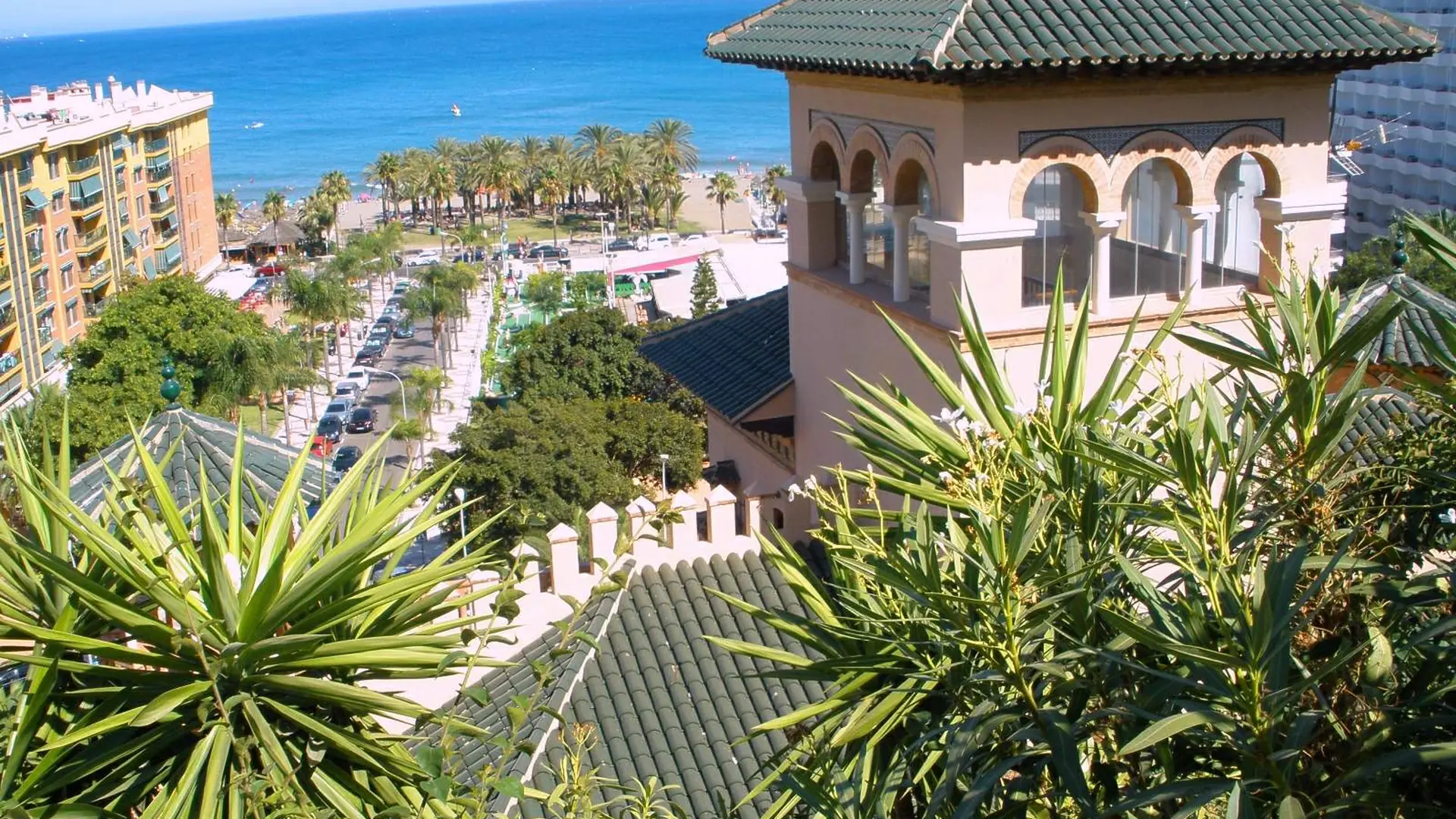
The reason to go is the height. From the upper terraces you get the whole bay in one frame, which is something no amount of promenade walking gives you. In summer the park closes through the hottest part of the afternoon and reopens into the evening, staying open until 22:00 – which makes it one of the few genuinely pleasant things to do in this town after dinner that does not involve a bar.
Where the nightlife actually is
Two streets carry the evening, and they do different jobs.
- Calle San Miguel is the pedestrian spine running from the town centre down towards El Bajondillo. It is retail by day and tables-out by night, and it peaks on a weekday evening from about 20:00. The tapas bars one turning back from it are consistently better than the ones fronting it, for the obvious reason that the frontage rent shows up on the bill.
- Plaza de la Nogalera is the centre of Torremolinos's LGBTQ+ scene, which has been one of Spain's strongest since the 1970s. Bars and terraces around the square run year-round, peaking from June to September and on weekends outside summer. There is no entry cost to the area and drink prices sit in line with the rest of the coast.
The two best days out are not in Torremolinos
This is the honest part. The strongest single day available from a Torremolinos base is an hour inland, and the second is one train stop east.
Caminito del Rey. The gorge walkway at El Chorro is the province's standout day out: 7.7 km of boardwalk bolted to a limestone cliff about 100 metres above the river. General self-guided entry is €10, and the official guided visit is €18 – a distinction this page got wrong for months by quoting the guided price as if it were the base fare.
From Torremolinos you can reach it by train with a change at Álora, or take a guided tour with return transport from around €50. The tickets are the hard part: they are released in a few large batches a year rather than on a rolling calendar, and our Caminito del Rey ticket guide explains what still works once your date shows sold out.
Dolphin trips from Benalmádena. Boats leave from Puerto Marina, ten to fifteen minutes away by taxi or Cercanías, and several operators run from the same quay selling quite different things – one hour from €20, or two hours from €40, depending on the boat.
Sightings are common on this stretch but nobody guarantees them, and the published sighting rates are lower than the marketing suggests. The Benalmádena dolphin watching guide compares each operator and what they actually publish.
While you are over there, the Benalmádena cable car climbs to 769 metres from the same town, which makes a marina-plus-summit day out of a single trip east.
Getting here, and getting around once you are
Torremolinos is one of the easiest arrivals on the Costa del Sol, which is a large part of why the town exists in its current form.
- From the airport: roughly 15 minutes by road, or take the Cercanías C1 directly – the airport sits on the same line. A private transfer from Málaga Airport is the simplest option with children or heavy luggage.
- From Málaga city: Cercanías C1, about 25 minutes, running frequently through the day.
- Around town: everything in this guide except Caminito del Rey and Benalmádena Marina is walkable from the centre. The promenade is the fastest flat route between the beach zones.
- Best months: May, June, September and October give you the same attractions with lighter crowds and lower room rates. July and August are peak for everything, including queues at Aqualand.
For a base rather than a day out, the Torremolinos travel hub covers where to stay and what the different zones are actually like, and the day trips guide ranks everything within reach beyond the two above.


Reader Comments 💬
Share your experience or ask a question